The Classical Primer
A guide for Catholic school leaders and teachers to the science and art of classical education: what it is, why it works, and how to teach it on Monday morning.
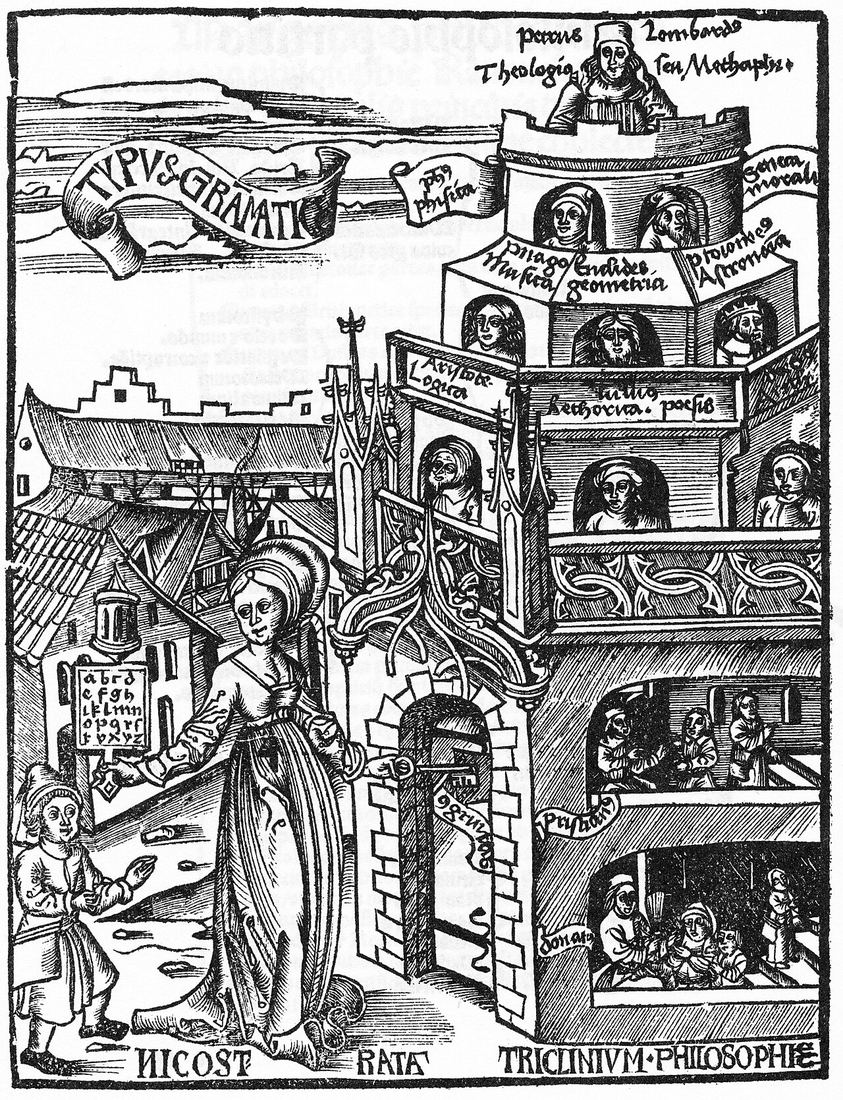
Classical Catholic education forms the whole child, body, heart, and mind, for wisdom, virtue, and ultimately sainthood. Its shape is very old. In 1503 Gregor Reisch opened his textbook, the Margarita Philosophica, with a woodcut of a tower of learning. At the door, a figure of Grammar hands a young boy a hornbook, the alphabet tablet that was a child’s first primer, and unlocks the tower with a key. Inside, each floor is a stage of study. Grammar fills the ground floors. Logic, rhetoric, and the arts of number come next. Natural and moral philosophy rise above them, and theology crowns the top.
This primer climbs the same tower, floor by floor, using the six-part model that Kevin Clark and Ravi Scott Jain recovered in The Liberal Arts Tradition.
Choose a floor
Choose a floor to enter it.
Three ways in
- If you lead a school
- Begin with the model, then mission and motto and the evidence. The case studies and the three-year renewal plan show what change looks like in real buildings with real budgets.
- If you teach
- Find your floor in the tower, then open the technique library and filter it by your grade band. Every technique is something you can try this week.
- If you need to explain it to a parent or a board
- Read classical and conventional, side by side and the short summary of outcomes. Five minutes, and you will have the words.
It trains the mind to think. Memory, logic, and eloquence are taught as arts, practiced daily, and mastered over years.
It shapes the soul to love what is true, good, and beautiful. Stories, song, art, and nature tune the affections before analysis begins.
It points the moral compass to true North. Grounded in piety and governed by theology, every subject leads back to Christ, which is why graduates can stand steady in a secular age.
The model
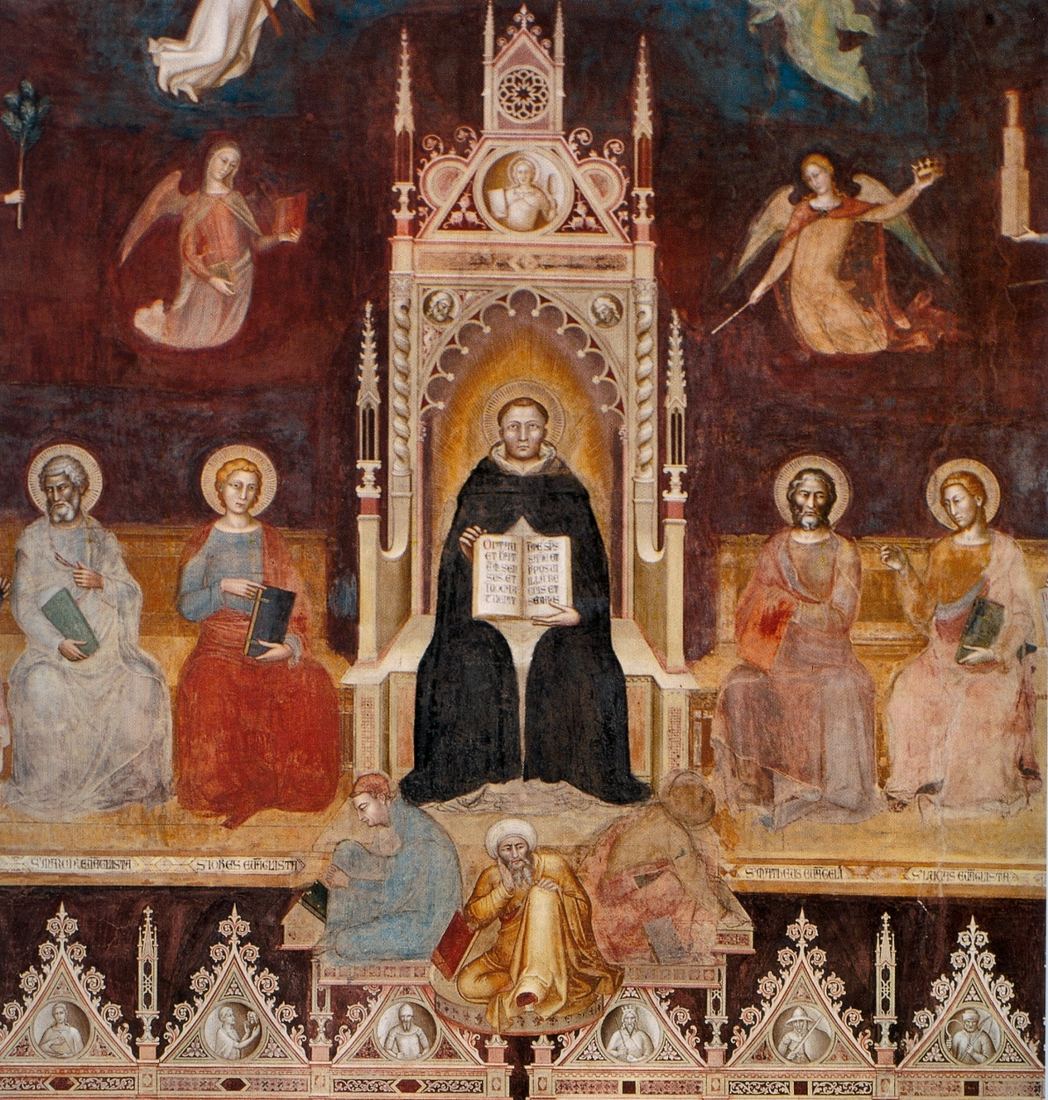
Every page of this primer hangs on one paradigm: piety, gymnastic, music, the liberal arts, philosophy, and theology.
Clark and Jain abbreviate their paradigm PGMAPT. The A stands for the liberal arts. Their book was first published in 2014, revised in 2019, and issued in a third edition in 2021 by Classical Academic Press.
Kevin Clark and Ravi Scott Jain taught together for years at the Geneva School in Winter Park, Florida. Their argument is simple, and it changed the conversation. The seven liberal arts were never meant to be the whole curriculum. They form the intellect, but a child is more than an intellect. A full education forms the body, the heart, and the mind, inside a life of faith, and leads them all toward wisdom.
So they placed the seven arts inside a larger order of six parts, each one resting on the one below it. Their summary is the best short description of classical Christian education we know: it is grounded in piety and governed by theology.
What, when, and why
Three voices help a school use the model well. They are not rivals. Each answers a different question.
Clark and Jain give the what
The whole house, in six floors. Piety is the foundation. Gymnastic and music train the body and tune the heart. The liberal arts give the mind its tools. Philosophy gathers what is learned into wisdom. Theology, the queen of the sciences, crowns and governs it all.
Dorothy Sayers gives the when
In her 1947 Oxford lecture, The Lost Tools of Learning, Sayers noticed that children pass through three ages that fit the three arts of the trivium. The Poll-parrot loves to memorize, the Pert loves to argue, and the Poetic longs to express. She matched grammar, dialectic, and rhetoric to those ages. Her timing remains a wise, practical guide, and many of the best Catholic schools build on it openly.
Sayers placed grammar at roughly nine to eleven, dialectic at twelve to fourteen, and rhetoric from about fourteen, with the quadrivium beginning around sixteen. The familiar American pattern of grammar in K–5, logic in 6–8, and rhetoric in 9–12 is a later adaptation of her idea.
Stratford Caldecott gives the why
In Beauty in the Word, Caldecott took his cue from Sayers and deepened her. He recast the three arts as Remembering, Thinking, and Speaking, and rooted them in the life of the Trinity and in Christ the Logos. For Caldecott the arts are not stages a child outgrows. They are powers of the human person that work together at every age, and the liturgy is their first school.
The six floors at a glance
| Floor | What it forms | Virtue it trains | Where it begins |
|---|---|---|---|
| I. Piety | Right love and fear of God and neighbor | Justice, which gives God and others their due, and charity | At home and at the altar, before school |
| II. Gymnastic | The body and its habits | Fortitude | From the first years |
| III. Music | The heart and the imagination | Temperance | From the first years |
| IV. Liberal arts | The mind, through language and number | Wisdom, and with it prudence | Roughly grades 3 to 12 |
| V. Philosophy | Wisdom about nature, man, and being | Wisdom and justice | Middle school, flowering in high school |
| VI. Theology | Understanding of God, who governs all | Faith, hope, and charity | Present from the start, studied formally last |
The virtue column follows Clark and Jain, who draw on Alasdair MacIntyre’s reading of Plato. It is Plato’s three-part soul built into a school: the spirited part trained to fortitude, the appetites to temperance, reason to wisdom, and justice holding them in order. The Church names these the cardinal virtues, prudence, justice, fortitude, and temperance, and crowns them with the theological virtues of faith, hope, and charity. That is why piety, rightly understood, trains charity as well as justice: it begins as giving God and parents their due and grows into love.
Read it as a building, not a ladder you leave behind. A senior writing a thesis still needs a disciplined body, a tuned heart, and a life of prayer. The lower floors carry the upper ones for life.
How the floors map to the grades
The book’s definition, in one sentence
Clark and Jain define Christian classical education as the handing on of the church’s culture through “a faculty of friends who love the truth.” That culture forms virtue in body, heart, and mind, and it nurtures the love of wisdom and faithful service to Christ. Two words carry the weight. Handing on means education is enculturation, not just instruction. Friends means the school is a company on a road, and the road ends at the marriage feast of the Lamb.
Behind this stands Augustine’s conviction that education shapes loves. It also stands on Anselm’s credo ut intelligam, belief that opens the way to understanding. David Goodwin draws the practical lesson in his foreword: “classical Christian” does not mean classical education with a Christian layer on top. It points back to the medieval synthesis of the seven arts, with Christ at the center.
Why they wrote it: four goals
Clark taught philosophy, theology, logic, and rhetoric. Jain taught mathematics and science. Working side by side for about fifteen years, they found the usual categories of the renewal too small for what drew them to the tradition. Integration was praised in theory and fuzzy in practice, and teachers kept wandering into one another’s territory. The preface names four aims for the paradigm.
- Put Christian formation in front. Education hands on values and culture and puts the loves in order. It does not only move information.
- Honor music, art, and the body. Schools often file them under “grammar,” which the authors call awkward and unhelpful.
- Give language arts and mathematics a full account. Mathematics has been central since Plato, and the modern sciences grew from it.
- Open a path to integration. Faith and science, language and number, the natural and the social sciences should be able to talk to one another, and the change should grow from inside the tradition.
C. S. Lewis pictured the medieval synthesis as both as orderly as the Parthenon and as crowded as a London station on a holiday. Clark and Jain want the model to show the order and the busy traffic between the parts. Littlejohn and Evans had already said the trivium is not enough. Clark and Jain finish the thought: the seven arts train the intellect, and a person is more than an intellect.
Virtue as ordered love
The revised edition adds a section on how classical education forms virtue. Its anchor is Augustine’s account of seven steps toward wisdom in De Doctrina Christiana: fear of the Lord, piety, knowledge, resolution, the council of compassion, purification of the heart, and wisdom. The authors tie them to the gifts of the Holy Spirit, as Aquinas does in the Summa (I-II, q. 68), and read them as a map of formation. Wonder before God turns to fear when we see our sin, repentance and faith turn fear into love, and knowledge of Scripture teaches us to love God for his own sake and neighbor for his sake.
- Ordered love. For Augustine, true virtue is love in right order. Love binds the other virtues together (Colossians 3:14).
- The four cardinal virtues on the soul. The authors map prudence to the mind, temperance to the appetites, fortitude to the will, and justice to the right order of all three.
- Philo’s addition. Philo of Alexandria read the Ten Commandments as teaching these virtues together with piety, and early apologists used his insight.
- Discipline of body and heart. Fasting, prayer, and song train the body and tune the heart. Resolution is turning from passing things to lasting ones.
- Virtue as participation. Gregory of Nyssa taught that human virtue is a sharing in Christ, who is virtue itself. Education without piety and grace, the authors warn, makes clever pagans.
Their practical lesson is that character formation cannot be a program added to the school day. It is the school’s purpose.
Where this sits in the renewal
David Goodwin, president of the Association of Classical Christian Schools, describes four generations of the modern renewal. The first, in the 1990s, was built on Sayers and the trivium. The second added integration and the Great Books. The third turned to virtue and the training of the affections. The fourth, from about 2018, gathers the seven arts within three spheres of knowledge, and Goodwin names Clark and Jain’s book as its guide.
Clark and Jain write from Protestant classical schools, but their paradigm is at home in Catholic schools. It leans on Augustine and Aquinas, it carries a foreword by Peter Kreeft, and it rests on the Catholic conviction that grace does not destroy nature but perfects it. This primer reads their model alongside the Church’s own teaching on education. For a recent shared statement of that teaching, written by bishops and school leaders, see the Front Royal Statement.
Sources
- Kevin Clark and Ravi Scott Jain, The Liberal Arts Tradition: A Philosophy of Christian Classical Education, 3rd ed. (Classical Academic Press, 2021), including David Goodwin’s “A Short History of Classical Christian Education’s Recovery.” Publisher
- Dorothy L. Sayers, “The Lost Tools of Learning” (1947). Text at ACCS
- Stratford Caldecott, Beauty in the Word: Rethinking the Foundations of Education (Angelico Press, 2012). Publisher
Inside The Liberal Arts Tradition
A reader’s guide to Clark and Jain’s book: how it is built, what each part argues, and what a school can do with it on Monday morning.
The book is long, footnoted, and generous. A busy dean or teacher can easily read the opening chapters and miss the rest. This guide walks through it in order. It gives the main argument of each part, the ideas worth remembering, and the practical questions the book raises for a school. It is a map, not a substitute. Read the book itself, and keep the footnotes close, because the authors use them to point to the best scholarship.
The authors write from Protestant classical schools. They cite Calvin, Kuyper, and Bavinck as readily as Augustine and Aquinas, and the structure of their argument is at home in a Catholic school. Where a Catholic resonance helps, this guide says so plainly.
How the book is built
| Section | What it does | Main page on this site |
|---|---|---|
| Front matter | David Goodwin’s history of the renewal, Peter Kreeft’s foreword, a publisher’s note on the revised edition, Christopher Perrin’s foreword, and the authors’ preface | The model |
| Introduction | The six-part paradigm, the definition of Christian classical education, and the case that the seven arts are not the whole curriculum | The model |
| Part 1 | Piety, gymnastic, and music, the imitative and poetic foundation | Piety, Gymnastic, Music |
| Part 2 | The liberal arts as seeds and tools: grammar, dialectic, rhetoric, and the four mathematical arts | The liberal arts |
| Part 3 | Philosophy in three branches: natural, moral, and divine | Philosophy |
| Part 4 | Theology as the science of revelation, then the education it governs: calling and discipleship, the formation of virtue, culture for the church, and the curriculum as a course to be run | Theology, Scope and sequence |
| Part 5 | Notes toward pedagogy and practice: wonder, reading, natural science, languages, and the choice of books | Good books and great books, Technique library |
| Appendices | Sample grade-by-grade reading lists, four checklists for school leaders, and a glossary | Good books and great books |
The revised edition adds a section on classical education and the formation of virtue. This guide treats it under Virtue formation, below.
Front matter and the paradigm
Goodwin sets the scene. He sketches four generations of the renewal, from Douglas Wilson and Dorothy Sayers through the Great Books, the training of the affections, and finally a synthesis in which the seven arts sit inside a larger vision with Christ at the center. Kreeft answers the usual objections to classical schooling by showing that each describes a strength. Perrin calls the book the third span of a bridge begun by Wilson and by Littlejohn and Evans. The preface and introduction then state the thesis. The seven liberal arts form the intellect. A person is also a body, a heart, and a will, so a school needs six categories: piety, gymnastic, music, the liberal arts, philosophy, and theology.
- The authors’ definition is the handing on of the church’s culture through a faculty of friends who love the truth.
- Plato’s Republic supplies the pattern. Gymnastic trains fortitude, music temperance, the arts wisdom, and justice holds the whole in order.
- Education shapes loves. Augustine’s ordered love is the thread through every part.
- Theology is a servant queen. She governs by nourishing the other subjects from within.
- The preface names four goals: Christian formation first, honor for music and the body, a full account of language and number, and a path to integration.
- Perrin says the model speaks to kindergarten teachers who ask how to teach classically when they do not teach Latin or logic.
- Goodwin’s warning is that “classical Christian” does not mean classical education with a Christian layer added.
For your school
- Use the six-part model as a common language for faculty meetings, so that a kindergarten teacher and a physics teacher can both see where their work sits.
- Put the definition in your faculty handbook and ask each department what “friends who love the truth” would mean in its classrooms.
- Prepare the Kreeft replies in advance for open houses and board questions. The side-by-side chart can help.
Part 1: Piety, gymnastic, and music
The first part argues that education begins before argument. Children are shaped by what they love, by what they do with their bodies, and by the stories and songs that tune their hearts. Piety comes first because without it nothing else can be taught well. Gymnastic and music follow, and the authors argue that schools already do much of this work but mislabel it as “grammar.” They want it named and honored.
- Weaver’s diagnosis. Modern man rebels against nature, neighbor, and the past. Piety is the remedy.
- The culture of a school educates as much as its curriculum. Manners, prayer, decor, and the choice of what to read are all part of it.
- Piety in the sources. Cicero, Gregory Thaumaturgus, and Augustine each tie piety to virtue. Aquinas’s broad sense and Augustine’s narrow sense both survive in the tradition.
- Gymnastic is formal education. It trains fortitude and temperance, and it brings children into direct contact with sensible reality, as Dennis Quinn taught.
- Body and soul. The authors cite Irenaeus for the view that both bear the image of God, and they conclude that no Christian school should undervalue physical education.
- Music is soulcraft. Songs, stories, and pictures form the heart and the intuition that grasps first principles.
- Participation. Music teaches by sharing in what is loved, which is why nursery rhymes and chants matter.
- Do not call it grammar. Chanting, dramatizing, and memorizing in the early years are musical education with a capital M, and the main work of those years is forming the heart.
For your school
- Audit the day for piety: how students greet adults, how prayer is led, how the school remembers its founders and saints.
- Protect recess, handwriting, sport, crafts, and nature time in the schedule, and explain them to parents as formation.
- Give early-grade teachers poems, songs, and stories to teach, and let wonder come before testing.
- Read more in Piety, Gymnastic, and Music.
Part 2: The liberal arts
The second part defines an art as a skill that joins imitation with reason, and a science as demonstrated knowledge. The liberal arts are the habits that produce works of reason, such as arguments, speeches, proofs, and measurements. Each of the seven gets a historical account and a plan for teaching. The authors argue that the trivium and the quadrivium both belong, that mathematics deserves a central place for formation as well as use, and that the arts must not be cut off from the great texts that gave them life.
- Art and science. Augustine’s songbird can imitate but has no art. Art is the nexus of imitation and science.
- Grammar is being at home in language: speaking and hearing first, memory and intuition next, analysis last.
- Dialectic is following questions. Logic judges arguments, but dialectic finds the questions worth asking, as in Plato’s dialogues and the medieval disputed question.
- Rhetoric has five canons and three species, and it takes character as seriously as skill.
- The quadrivium. Arithmetic, geometry, music, and astronomy were defined by their relation to rest and motion, and each was a road to wisdom.
- Euclid before algebra. Constructions come first, then proofs. The authors argue that geometry should precede algebra and that Euclid’s Elements deserves a place in the school.
- Astronomy and music. They are the two sides of Kepler’s program and the paradigm of the sciences that join mathematics to nature.
- Four goals for mathematics. Wonder, work, wisdom, and worship.
For your school
- Stop calling every subject’s early content “grammar.” Keep the word for language, and name the rest by what it does.
- Teach dialectic by modeling questions in every class, and keep the full disputed question for upper grades.
- Review the math sequence. Consider geometry before algebra, constructions before proofs, and a place for Euclid in the middle or upper school.
- Start with puzzle, proof, and play before drill. See the technique library and The liberal arts.
Part 3: Philosophy
The third part recovers philosophy as the love of wisdom and the unity of knowledge. Against the Sophists, who reduced truth to power, Plato held that reality can be known and that knowing asks for submission. Medieval thinkers divided philosophy into natural, moral, and divine branches, matching the threefold order of God, man, and world. The authors show how modern science and social science grew from natural and moral philosophy and then lost the questions of purpose that once held them together. They propose recovering all three branches, using the liberal arts, the four causes, and a historical, narrative way of teaching.
Natural philosophy
- Philosophy is for lovers. Love and truth belong together.
- Scientia means demonstrable knowledge of causes. Natural philosophy is the older name for science.
- The four causes were reduced after Galileo to matter and force. The authors want all four restored.
- Laws and covenant. The regularities of nature are part of God’s faithful love for creation.
- Two stances. Tolkien’s Elves work with nature, and the Orcs ravage it. Hugh of St. Victor’s common arts belong to the first.
- Justify what you know. Textbooks are the weakest authority. Students should retrace discoveries and rebuild experiments from primary sources.
Moral philosophy in depth
This is the longest stretch of the book, and it is easy to underrate. The authors argue that the social sciences grew out of moral philosophy and cannot be understood apart from it. Moral philosophy asks what a human being is and what he is for, and then asks how families, churches, markets, and states serve that end.
- A whole, then fragments. The old moral philosophers wrote on politics, law, economics, and language as parts of one pattern. Reading a single piece as modern specialization misses what they assumed.
- No value-free science. The split between “positive” and “normative” inquiry is a fallacy. Questions about human nature and happiness cannot be set aside.
- The failure of confident reason. Descartes’s method of doubt led to a faith in autonomous reason. The nineteenth-century belief in progress then broke on the twentieth century, above all under Freud’s account of the unconscious.
- Ends before means. Human action aims at ends. For Christians, the final end is union with Christ. An economy that assumes insatiable desire has no idea of enough.
- Persons and communities. The authors reject the view that altruism is a vice. The flourishing of a community and the happiness of a person interpenetrate.
- Moral philosophy is practical. Aristotle placed it late, after a foundation of habit. Families, churches, and cultures hand the habits down.
- Reductionism. Seventeenth-century mechanism reduced the human being to atoms in motion, and behaviorism treats the mind as a black box. Martin Seligman is a partial ally, because he brings back happiness and virtue, though he stops short of Christ.
- Image, fall, and mediating communities. Being made in God’s image grounds reason, relationship, embodiment, and will. Sin bends them. Modern individualism leaves the individual and the state facing each other with nothing between. The authors recover subsidiarity, a principle Catholic readers know, and Kuyper’s idea of separate spheres of authority.
The authors work out the same logic in several fields.
- Business as a school of virtue. Contracts teach justice and love, ordered self-love is not sinful, and profit is a sign of service. Greed and monopoly harm both the market and a free society.
- Church and state. Augustine’s two cities, one ruled by love of God and one by self-love, help Christians see their situation. Christ is the one true sovereign. The authors follow Charles Taylor in preferring principled pluralism to the removal of religion from public life, and they hold that parents bear first responsibility for schooling.
- Sin and law. A realistic view of sin explains limited government and the separation of powers. Natural law binds rulers as well as subjects. The law shows the gap between God’s holiness and our failure, and then guides those who believe.
- Mercy. Church-based works of mercy, such as the monasteries once provided, carry much of civil life. The authors suggest the church’s ministries of mercy could again outshine the state’s services.
History as the counterpart of moral science
The Greek historia means inquiry. Just as natural philosophy needs natural history, moral philosophy needs the history of human customs, institutions, and ideas. The authors worry that disciplines such as economics have dropped their own history. Christopher Dawson’s view is that sociology and history are two halves of one science of social life. One economist’s analogy shows the cost. Relying on Adam Smith’s economics alone is like trying to solve for four unknowns with two equations, so the answer stays open and the debate endless. Tracing how views of man have changed supplies the missing equations. They also favor omnibus courses, in which history, literature, politics, economics, and philosophy are studied together in one period.
The eight marks of a Christian moral science
- An economy is an organic outgrowth of a society’s traditions and relationships, not an experiment to be tinkered with.
- Persons are loving and communal, not only self-interested maximizers.
- Because of sin, no government, however well meaning, should be trusted to build utopia.
- Liberty is real, but autonomy is not the final goal. Individual and community shape each other.
- Freedom is sought within churches and real communities, and joined to responsibility.
- Time, place, institutions, and relationships are taken seriously as the fixed setting of a people’s life.
- Politics is not cut off from economics, and the sciences are held within a view of the whole of knowledge.
- Facts and values are not divorced. Values can be discussed objectively, and technology and progress are tied to a society’s purposes.
Dawson’s warning closes the section. A sociology cut off from its limits can build utopias but cannot help a statesman. It should neither take over philosophy and theology, as Comte tried, nor ignore moral and spiritual values, as Marx did.
Divine philosophy
- Being as being. Aristotle’s metaphysics studies what is true of everything that is. The medieval answer was the transcendentals: being, unity, goodness, and truth. Many add beauty, and Maritain and Gilson helped revive that claim.
- Everything shows the marks. If the transcendentals hold, every creature reflects goodness and unity in some measure, even the worst of men.
- Why nominalism matters. Ockham denied that real universals exist. Hume held that causality is only habit, and instrumentalists treat theories as tools. Each undermines science as knowledge of causes and leaves open the question of what a man is. Several scholars trace secular modernity back to this turn.
- Guardian of the secret questions. Metaphysics protects the meaning of words. If a judge and a defendant cannot share the meaning of a word, a culture cannot reason together.
- Participation. The fathers and medievals sought to be mastered by truth, not to master it. Created things share sacramentally in Christ’s mystery.
- Grace perfects nature. The authors note that Reformed thinkers such as Vermigli and Bavinck also affirmed it. Because God does not displace the natural order, science is not hostile to faith.
- The mark of the Maker. Pascal called nature an image of grace, and Augustine saw traces of the Trinity in creation. Metaphysics lets students ask how Christ holds one and many, quantity and quality together.
- Recover realism. The authors argue that being comes before knowing, and they call Gilson’s Thomist realism the most natural home for the model. They accept other realisms where compatible, and they name the perennial philosophy that kept all four causes as the tradition to join. Metaphysics is the capstone of philosophy, and the branches should not be sealed off from one another.
For your school
- Teach the four causes with a simple object, such as a marble statue, in science and literature classes alike.
- Ask students why a formula holds and where it fails, not only how to apply it, and give seniors primary sources in science.
- In social studies, begin with what it means to be human, and teach each discipline’s history beside its theory.
- Hold a seminar on a question such as “What is a man?” or on the causes of a single event. Have students define their terms first. See Philosophy.
Part 4: Theology, the queen of the sciences
Theology is the science of divine revelation, with Scripture, Christ, and the living church at its center. The authors cite Aquinas for the point that a body of knowledge given by God stands beside philosophy, and that medieval schools were right to call theology their queen. Christian schools usually include theology in some form, they say, from intuition rather than from a clear view of why it is necessary or where it belongs. Their aim is to set it at the end of the curriculum and to show how it unifies the rest.
- Three common approaches. Schools offer separate courses, weave theology into other subjects, or fold it into school life through prayer and worship. Each captures part of the truth, but none is yet the theology that crowns the curriculum.
- Revelation beyond reason. Scripture reveals creation, the fall, and redemption in Christ, which reason alone cannot reach. The classical world had no science of them, so one is needed.
- Reading rightly. Scripture is read in submission to Christ’s lordship, within the people of God and beside the living tradition of the church. Catholic readers will hear the Church’s Tradition in that phrase.
- Theology grounds the lower floors. It gives piety its object, the body its dignity as an image-bearer, and music its stories, poems, and songs of worship.
- The source of unity. The idea that all things hang together comes from creation. MacIntyre argues that philosophy cannot be understood apart from God.
- Presuppositions supplied. Theology gives natural philosophy the ideas of creation and contingency, and moral philosophy the idea that human beings are persons.
- A narrative frame. Revelation has a story shape, and without it, history is an endless plurality of readings.
- Telos. Following Aristotle, the end of a thing is what matters most. Theology is the end of the curriculum, not only its summit. The authors cite Mark Noll’s complaint that American seminaries cut theology off from other learning.
For your school
- Map where theology lives now: courses, other subjects, and school life. Ask what is missing from each.
- Place Scripture and Church documents beside history and literature units from the same period.
- Run a senior seminar on how natural, moral, and divine philosophy each relate to revelation. See Theology.
Calling and discipleship
A curriculum cannot be discussed apart from the calling and culture of the community that holds it. The authors use the Greek paideia for the handing on of a culture’s loves, norms, and values, and they note that cultus, worship, and culture share a root. What adults worship is what they will hand on. If a school only trains skills for the economy, it makes no moral demand on parents, and education becomes something outsourced. They set Christian education against that, as discipleship of the youngest members of the church.
- The parents’ calling. The Shema (Deuteronomy 6:4 to 9) and Paul’s charge to fathers (Ephesians 6:4) place the first duty on parents. The authors cite baptismal promises as the frame, and Catholic parents will recognize their own at the font.
- Words that teach. “Mathematics” first meant learning. “Disciple” and “student” share a root, and “master” comes from the word for teacher. The question is always whom the student is being discipled to.
- Imitation as participation. Greeks and Christians both put imitation at the center. Gregory of Nyssa held that imitating Christ flows from sharing in him. Augustine read Plato as reaching for the same end.
- Teachers worthy of imitation. The first qualification for faculty is that they know Christ and follow him.
- In loco parentis. Teachers act for parents and the church. The authors recall Charlemagne’s order of 789 for monastery schools and Theodulf’s order of 797 for parish schools, taught freely.
- No sacred and secular zones. Splitting school into secular learning plus Bible and evangelism implies God has no interest in much of life. Kuyper’s claim is that Christ rules every square inch.
- Believe and obey. Discipleship is not theory first and practice second. Hearing, believing, and obeying are one act, and Anselm’s credo ut intelligam names the order.
For your school
- Say at enrollment that education here is discipleship, and state the promises parents already made.
- Hire and review teachers first for whether they are worth imitating, then for skill.
- Keep pastors and parents in the loop on formation, and be clear that the school acts for them. See Mission and motto.
Virtue formation
The revised edition adds a section on classical education and the formation of virtue. Its center is Augustine’s account of seven steps toward wisdom in De Doctrina Christiana. The authors link them to the gifts of the Holy Spirit, as Aquinas does, and read them as a map of Christian formation. Virtue, in the end, is ordered love: loving God for his own sake and neighbor for God’s sake.
- The seven steps. Fear of the Lord, piety, knowledge, resolution, the council of compassion, purification of the heart, and wisdom.
- Fear, then piety. Wonder at God turns to fear when we see our sin. Repentance and faith turn fear into love and submission to Scripture.
- Knowledge for the whole person. Laziness, shirking hard thought, and daydreaming of fame all misdirect the loves. The Platonic virtues map onto the soul: prudence for the mind, temperance for the appetites, fortitude for the will, justice ordering all three.
- Resolution through discipline. Fasting, prayer, vigil, and music train body and soul. The authors defend the desert fathers and Benedict’s ora et labora against modern embarrassment.
- Compassion and purity. Worship cut off from justice and mercy is worthless. Augustine’s distinction between use and enjoyment teaches us to love neighbors in God.
- Wisdom learned in service. Augustine commends the liberal and common arts with discernment. Maximus the Confessor adds that true wisdom is acquired in service.
- Philo and the cardinal virtues. Philo of Alexandria read the Ten Commandments as teaching the classical virtues together with piety. Early apologists used the idea, and Augustine finishes it with ordered love.
- A warning. Education without piety and grace produces clever pagans, the authors say.
Christian revelation, the authors say, makes love the chief virtue, with faith and hope beside it, and love binds the other virtues into one. In the same spirit, parents are asked to trust God’s promises rather than judge the state of a child’s faith.
For your school
- Use the seven steps as a formation map for advisory or retreat programs, grade by grade.
- Build spiritual disciplines into the year: silence, fasting, memorizing Scripture, service. Follow each with written reflection.
- Run a “loves audit” in which older students list what they desire and order it. Pair prudence, justice, fortitude, and temperance with mind, will, and appetite in your character language.
- Link service and labor to learning, so that wisdom is practiced and not only studied.
Culture and curriculum
Having defined education as discipleship, the authors turn to culture. Worship produces culture, and the church makes the invisible kingdom visible in how it prays and lives. Every polity has a worship at its core, and every school passes one on. Secular schooling has its own dogmas and cannot be neutral. The authors then define the curriculum, in its old sense, as the course the students run, set out by experienced runners who know the terrain.
- Cultus creates culture. The authors recall that Nicaea II distinguished worship due to God alone from the honor given to creatures. The distinction lets festival flourish without idolatry, a point Catholic readers will know well.
- Idols as background. Money, power, and personal freedom shape their worshipers. Calvin called the human heart a forge of idols. The authors adapt Churchill’s remark: we shape our idols, and then they shape us.
- Dewey’s church. The authors read progressive education as a civic religion with its own sacred abstractions, and they conclude that Christian schools cannot copy public schools and add a Bible class.
- Plundering the Egyptians. Because God scattered wisdom and natural law widely, Christians may take true learning from pagans, as Augustine taught. Augustine did it with Plato, Aquinas with Aristotle, and other cultures may do it with their own classics.
- Dawson’s pattern. Christian culture grows through confrontation, permeation, and new forms. The church flourishes by redeeming surrounding cultures, not erasing them.
- A faculty of friends. A school is a company at leisure, whose shared life draws students into the conversation. Without that, the school is a building full of instructors.
- Festival and leisure. The curriculum is ordered toward joyful contemplation of God. Modern events try to supply transcendence without it, and James K. A. Smith’s “cultural liturgies” name how they form people. Knowing combines the work of reasoning with the receptive seeing of the intellect.
- Three kinds of art. The liberal arts are pursued for their own sake, the common arts serve bodily needs, and the arts of the beautiful, in Gilson’s phrase, capture us for goodness and truth. Confusing the first two risks a culture of total work. The authors picture the whole as a circle governed by theology, leading further up and further in.
For your school
- Build worship, feast days, and festival into the calendar, and ask what your assemblies and athletic events are teaching students to worship.
- Review hiring and governance with the faculty of friends in mind: time to talk, read together, and plan across departments.
- Give students at least a taste of the common arts, such as cooking, weaving, building, and gardening.
- Hold a faculty retreat to map the curriculum as a course. Read the Front Royal Statement beside it, and see Renewing a whole school.
Part 5: Notes toward pedagogy and practice
The fifth part is brief and illustrative. It moves from the history and philosophy of the curriculum to its practice, and it begins where Aristotle did, with wonder. The authors say pedagogy should direct students to the goodness, truth, and beauty of the things themselves, in nature, language, number, history, and God. That frees teachers from expensive technology and anxious technique, and it asks them to teach with rest. Their mottos for the road are non multa sed multum, not many things but much, and festina lente, make haste slowly.
- A feast, not a buffet. Students take part in a feast of the true, good, and beautiful. Their participation is real but peripheral, fitted to their ability, like a young violinist in an orchestra or a child at the family table.
- Beyond a false dilemma. The authors reject both teacher-centered conventional schooling and student-centered “twenty-first-century” learning. The better path is teaching aimed at what is real.
- Deep reading. The modern failure is not decoding but being addressed by a text. Lewis’s image of looking at a beam, along it, and at what it lights shows three modes of reading: for knowledge and memory, for language, and for creative appropriation by the imagination.
- Mathematics as a liberal art. Children measure real things first, then recapitulate great historical problems, then take up puzzles and proofs.
- A new natural philosophy. The authors read Huxley and Lewis as warnings about power over nature without knowledge of nature. Their three themes are a holistic curriculum with natural history and the common arts, incarnational pedagogy that midwifes ideas through Socratic questioning, and interdisciplinary study with theology as queen.
- Languages. The trivium needs Greek and Latin to keep its integrity, because the roots of Western ideas lie in those tongues. The authors concede that one scholar overstates the case, and they affirm translation, grounded in the Word made flesh. They treat the return to the sources as a long-term goal.
- Canon, not list. Readings should work like episodes in a larger story, creation, fall, redemption, and consummation. Dawson’s Christian view of history lets us read the pagan classics as preparation. Stories shape us morally, as MacIntyre argues.
- Good books first. Senior’s thousand good books prepare the soil for the great ones, and the book ends the reading guidance with Dante. Each school should build its own list, and the aim of reading is growth in piety, wisdom, and virtue.
For your school
- Cut coverage before depth: fewer texts, read aloud and slowly, with dictation, copywork, memorization, and narration.
- Send science students outdoors with sketchbooks and retrace classic experiments before they use gadgets.
- Say at the start of each unit what the story is that the readings tell, and where the student fits in it.
- Build your own reading list in light of your community. See Good books and great books and Scope and sequence.
The appendices
The back of the book is practical. It offers sample lists, four checklists, and a glossary, and it says plainly that these are examples to adapt, not rules to copy. This guide describes them and does not reproduce the lists.
- Reading lists by grade. There is an early-years list, then lists from first grade through twelfth. The early lists lean on rhyme, verse, hymns, and Bible stories read aloud. The upper lists add whole books and excerpts, and they pair a classic with a challenger text for debate.
- Reading-mode codes. T means the teacher reads aloud, R means students read alone, RA means students read aloud, and RT means both. In fifth grade a book may carry a percentage split among the modes. From seventh grade the lists distinguish books read completely, books read in excerpts, and books assigned for the summer before.
- The Bible in every grade. A standing Bible title appears at each level, and the sample uses a Protestant translation. A Catholic school would use its approved text.
- Checklist for curriculum committees. About a dozen prompts test a list: Is the load light enough to be read deeply? Is each book mandatory or optional? Does it work as a read-aloud? Do classics outnumber recent books? Is the list reviewed every year or two?
- Checklist for administrators speaking in public. Keep learning, model the virtues, prepare, repeat the mission, tell stories, invite a witness, feature students, and choose one element of the liberal arts to stress.
- Checklist for parent meetings. Open with what the student does well and with prayer, state the partnership, ask what parents see at home, and focus on virtue before grades. For problems, agree on symptoms before causes.
- Checklist for report cards. De-emphasize numbers, consider none before high school, include a virtue section and a short teacher narrative, and use a rubric of beyond praiseworthy, praiseworthy, satisfactory, and not yet satisfactory.
- Glossary. It runs in the order the terms are first discussed, and the table below paraphrases it.
For your school
- Publish your reading list with the T, R, RA, and RT key at the top so parents can see what is read aloud.
- Run each new list through the committee checklist, and revise it on a schedule.
- Adapt the parent-meeting and report-card checklists for your own use. See Good books and great books.
Key terms
| Term | Meaning in the book | Where it matters here |
|---|---|---|
| PGMAPT | The authors’ abbreviation for piety, gymnastic, music, the liberal arts, philosophy, and theology | The model |
| Piety | Right love and reverence for God, and proper respect for parents, neighbors, and the communities that formed us | Piety |
| Ordo amoris | Augustine’s ordered love: virtue as loving each thing in right measure, God first | Piety |
| Enculturation | Handing on the culture of the church, which is how the authors understand education | The model |
| Paideia | The handing on of a culture’s whole set of loves, norms, and values. Also the generalist’s learning, as opposed to specialist episteme | The model |
| Cultus | Worship. The authors stress that culture grows from it | The Front Royal Statement |
| Gymnastic | Bodily training in the broad sense, supporting self-mastery and a moral imagination | Gymnastic |
| Musical education | The education of the Muses, early formation through imitation that builds wonder and prepares the imagination | Music |
| Seeds and tools | The liberal arts as tools that work the soil and seeds that grow into later knowledge | The liberal arts |
| Art and science | An art joins imitation with reason. A science is knowledge of things through their causes | The liberal arts |
| Trivium | The three arts of language: grammar, dialectic, and rhetoric | The liberal arts |
| Grammar | Being at home in language, both producing it and receiving it, with imitation before analysis | Technique library |
| Dialectic | Finding and testing arguments, reasoning validly, and carrying on inquiry and conversation | Technique library |
| Rhetoric | Seeing the means of persuasion and leading souls through speech, taught through five canons and three species | Technique library |
| Quadrivium | The four arts of number: arithmetic (discrete number), geometry (continuous magnitude), astronomy (the heavens in space and time), and music (number in time) | The liberal arts |
| Ad fontes | The humanist motto: go to the sources in their original languages | Good books and great books |
| Natural science | Demonstrable knowledge of causes in nature | Philosophy |
| Natural history | Observing, describing, and classifying natural phenomena | Philosophy |
| Natural philosophy | The love of wisdom about nature, joining natural history and natural science | Philosophy |
| Common arts (technology) | The arts that meet bodily needs, such as farming and building. The Greek word is techne | Philosophy |
| Four causes | Material (what a thing is made of), efficient (what made it), formal (its essence), and final (its purpose) | Philosophy |
| Moral science | Demonstrable knowledge of causes among human beings and society | Philosophy |
| Moral philosophy | The love of wisdom about human beings and society | Philosophy |
| Divine philosophy | The love of wisdom about all that exists, also called metaphysics | Philosophy |
| Transcendentals | Properties of everything that is: being, unity, goodness, and truth, with beauty often added | Philosophy |
| Nominalism and instrumentalism | Views that deny real universals or treat theories as tools. The authors see them as roots of modern skepticism about causes | Philosophy |
| Participation | Sharing in truth and in Christ, so that one is mastered by truth and does not master it | Philosophy |
| Wonder, work, wisdom, worship | The four goals the authors set for mathematics and natural science | The liberal arts |
| Theology | The science of divine revelation, centered on Christ and Scripture within the living church | Theology |
| Servant queen | Theology as the science that governs by nourishing the others from within | Theology |
| Telos | A thing’s end. Theology is the end of the curriculum, not only its summit | Theology |
| In loco parentis | Teachers act in the place of parents and with the church’s support | Mission and motto |
| Faculty of friends | The authors’ picture of a school: a community of teachers and students at leisure who love the truth | The model |
| Christian classical education | Passing on the church’s culture, aiming at a love of wisdom and faithful service to Christ | The model |
| Curriculum | The course students run, set out by experienced runners who know the ground | Scope and sequence |
| Canon | A body of readings arranged along an overarching story, not just a list | Good books and great books |
| Legitimate peripheral participation | Real practice fitted to a student’s ability, like a young violinist among players | Technique library |
Sources
- Kevin Clark and Ravi Scott Jain, The Liberal Arts Tradition: A Philosophy of Christian Classical Education, 3rd ed. (Classical Academic Press, 2021). Publisher
- Includes David Goodwin’s history, Peter Kreeft’s foreword, and Christopher Perrin’s foreword.
Classical and conventional, side by side
Most families have only known one kind of school. This chart is for the conversation at the kitchen table, the open house, and the board meeting.
| Catholic classical | Conventional | |
|---|---|---|
| The goal | Sainthood, wisdom, and virtue: to know, love, and serve God | College and career readiness |
| How success is measured | A well-ordered soul that loves the true, the good, and the beautiful, and the skills that follow | Proficiency scores, rankings, placement |
| Shape of the curriculum | Integrated. Theology, literature, history, and art travel through the same era together | Separate subjects with separate standards |
| Place of theology | Queen of the sciences, woven through every subject | One class among many, or none |
| What “liberal” means | Freedom. From the Latin liber, free: the education of a free person, able to know and follow the truth, who is Christ the Logos (John 8:32) | Preparing for the job market |
| Organizing principle | Piety, gymnastic, music, the seven liberal arts, philosophy, theology | Skills and standards frameworks |
| What students read | Good books and great books, primary sources, Scripture | Textbooks, excerpts, leveled readers |
| Daily methods | Narration, recitation, memory work, imitation of models, Socratic seminar, disputation | Lectures, worksheets, slides, projects, screen-based tasks |
| The teacher | A model and witness. Heart speaks to heart | A facilitator or content provider |
| Moral formation | Virtue as habit and rightly ordered love | Rules and social-emotional competencies |
| Pace | Leisure in the old sense: attention, wonder, depth. Not many things, but much | Coverage and acceleration |
| Primary educator | Parents. The school assists them | The school |
| Technology | Purposeful and limited. Phones stay off campus | Devices for every student, all day |
| Beauty and the arts | Essential: chant, sacred art, poetry, drama | Electives, often the first to be cut |
A classical school is not against good test scores or strong college placement. It simply refuses to make them the point. Students formed to think, read, and speak well usually do well on tests too. The difference is what the school is for.
Answering the objections
In his foreword, Peter Kreeft lists the standard complaints against a classical school: it is divisive, different, countercultural, old, judgmental, unspecialized, religious, and small. His reply is that each complaint, looked at squarely, names a strength. A few of his answers are worth having ready.
- “It’s old-fashioned.” A school can be traditional the way honor and fortitude are traditional. Judging an idea by its date is what Lewis called chronological snobbery. Kreeft says the true rebel is the traditionalist.
- “It’s countercultural.” A classical school gives adolescent rebellion something worth rebelling against, the new establishment, and something worth rebelling for.
- “It’s judgmental.” Kreeft observes that modern education is judgmental about everything except judgment itself. A school that teaches students to weigh truth and beauty is at least honest about it.
- “It’s small.” Small schools resist standardization and keep a child from disappearing into a system.
- “It doesn’t train for jobs.” It teaches students to think and to live well. Kreeft grants that its graduates may turn out to be philosophers rather than millionaires, and says that is no fault. Chesterton agreed that people need to be more than pragmatists.
- “It’s religious.” The school assumes grace perfects nature, the way light perfects colors. Faith does not shrink the subjects. It lets each one show what it is.
Piety
Before a child can learn, he must learn to love rightly. Piety is the foundation stone and the door of the tower.
What it is
Piety is the duty, love, and respect we owe to God, to parents, and to the communities and authorities that formed us, past and present. Clark and Jain put it most simply as the proper love and fear of God and neighbor. It is not a feeling. It is devotion that shows up in what we do.
St. Thomas Aquinas speaks of piety twice: as a natural virtue, by which we honor parents and country, and as a gift of the Holy Spirit, by which we honor God as Father and every person as His child. The school needs both. Natural piety teaches gratitude and courtesy; the gift lifts them into worship.
Aquinas treats the virtue of piety in Summa Theologiae II-II, q. 101, and the gift of piety in II-II, q. 121.
Why it comes first
The ancients believed education was, at bottom, the shaping of loves. St. Augustine defined virtue as rightly ordered love, ordo amoris. A child who resents his teachers, mocks his elders, or treats the past with contempt cannot be taught much that matters, however bright he is. A child who has learned gratitude, reverence, and trust can be taught almost anything.
This is also why a school’s culture teaches as much as its curriculum. The way a school prays, greets, dresses, celebrates, and corrects is itself a lesson in piety, given every day whether anyone plans it or not.
The beginning of wisdom is fear of the LORD, and knowledge of the Holy One is understanding.Proverbs 9:10
What the Church teaches
Parents are the first educators of their children, and the school assists them. That conviction runs through the Second Vatican Council’s Gravissimum Educationis, the Catechism, and canon law. Piety begins at home and at the altar; the school’s task is to support and never undermine it.
Stratford Caldecott adds a Catholic insight the whole primer leans on: the liturgy is the school of memory. In worship a community remembers who it is, receives its existence as a gift, and learns to answer with thanks. Prayer is not an interruption of the school day. It is the day’s center.
What Clark and Jain argue
Clark and Jain call piety the central tenet of Christian classical education and its sine qua non. Their case begins with Richard Weaver’s Ideas Have Consequences. Weaver called modern man impious: he rebels against nature, against his neighbor, and against the past, and then names the rebellion progress. Piety is the opposite habit. It is faithfulness to a tradition and a place, received with thanks.
The authors show how old and how widespread the virtue is. Virgil made pietas the mark of Aeneas and of Augustan Rome. Roman usage covered duty to the gods, the country, parents, and kin, and Cicero defined it that way. Socrates was tried for impiety and for corrupting the young. Emperor Ashoka used the Greek eusebia to render the Indian word dharma. Matteo Ricci judged Chinese reverence for ancestors to be a civil custom, and Pius XII settled the matter in 1939 by agreeing.
Cicero is also the source for the idea, repeated by Russell Kirk, that piety is the foundation of the other virtues. Gregory Thaumaturgus called it their mother. Augustine says in The City of God that true virtue exists only where there is true piety. Clark and Jain add that for about a thousand years Augustine’s narrower sense, worship of God, was the one in common use, while Aquinas’s wider sense, which includes family and country, stayed available beside it. They also read Calvin’s definition of piety as reverence joined with love of God, and Catholic teachers will find it close to Aquinas.
The school’s culture is a curriculum
The authors insist that the culture of a school educates as much as its curriculum does. Three consequences follow.
- Manners are piety made visible. How students speak to teachers and elders checks the pride of the individual and trains reverence.
- Place and history are taught on purpose. A student should see himself as an heir, standing in a particular town, church, and civilization.
- Reading lists are acts of piety. What a school chooses from literature and history says what it honors.
Samuel Huntington’s warning that the West must recover its roots supports their point. An education that claims to be neutral has no culture to hand on, and every education rests on a story and a practice, not on reason alone. The authors add that knowledge depends on obedience (John 7:17), and that piety begins at home and in church. The school’s task is to support what the family and the parish have begun.
In the classroom
- Open every class with a short prayer, and close the day together.
- Let the liturgical year set the rhythm: Advent and Lent, feasts of the saints, the school’s patronal feast.
- Make the sacraments easy to reach: regular Mass, Confession, and Adoration.
- Teach courtesy as a form of reverence: standing when an adult enters, greeting by name, thanking the cook.
- Honor the founders, benefactors, and those who came before, and tell their stories.
- Say the school motto aloud and often, so it becomes the students’ own.
- Pair older students with younger ones, so reverence is learned by watching someone admired.
By grade band
Read further
- Clark and Jain, The Liberal Arts Tradition, “Piety: Proper Loves, Proper Fears.”
- Romano Guardini, The Spirit of the Liturgy (1918), especially “The Playfulness of the Liturgy.”
- Sofia Cavalletti, The Religious Potential of the Child, the source of the Catechesis of the Good Shepherd.
- Thomas Aquinas, Summa Theologiae II-II, qq. 101 and 121. Free text
Gymnastic
The training of the body for the good of the soul.
What it is
Gymnastic is not just physical education. Clark and Jain describe it as the whole physical conditioning of a child, beginning with control of the body and ending, yes, in games and sport. It includes posture, handwriting, order, endurance, and the steady habits that make a person reliable. Like every part of education, it trains abilities a child already has rather than inventing new ones.
Plato placed gymnastic and music side by side at the start of education in the Republic. Gymnastic hardens the soul as well as the body, he argued, and music softens it. A child needs both.
Why it matters
A person is not a mind riding in a body. The Catechism teaches that the soul is the form of the body, so profoundly united that the two make one nature. What we do with our bodies forms who we become. Fortitude, the virtue gymnastic trains, is learned first in the legs and the lungs: finishing the race, holding still in line, keeping one’s temper after losing.
Attention lives in the body too. A child who can sit still, breathe, and look can listen. This is one reason the phone-free campus belongs on this floor.
The unity of body and soul: Catechism of the Catholic Church 362–368. St. John Paul II’s catechesis on the human body, the Theology of the Body (1979–1984), develops it.
What Clark and Jain argue
Clark and Jain insist that gymnastic is a formal part of classical education, not an extracurricular. Plato says in Republic III that gymnastic and music begin in early childhood and continue through life. That sits oddly beside the modern habit of pressing critical thinking on children as early as possible. The authors reconcile it with Sayers by noting that the early years run on memory and imitation. We can call that work what it is without labeling it “grammar.”
Ancient gymnastic was broad: whole-body conditioning, control of movement, and contests in running, swimming, and wrestling. A classical childhood also included singing, memorizing poems, acting, drawing, sculpting, hearing the deeds of heroes, and watching nature closely.
Contact with real things
The authors lean on Dennis Quinn and the Integrated Humanities Program at the University of Kansas in the 1970s, which also formed John Senior. Quinn held that gymnastic is training in direct contact with sensible reality, a contact that modern sports culture has largely lost. James Taylor, a student of that program, reported that college students who lacked early physical, first-hand experience needed it much sooner, at the elementary level. Modern life shields children from nature, from crafts, and from plain games.
Why the body belongs in the school
- We are composite beings. To call physical education “extra” is to forget the unity of body and soul. The authors cite Irenaeus, who taught that both body and soul bear the image of God, against a narrower reading of the image as reason alone.
- The body serves the mind. Reading is harder with a headache. Athletic discipline builds self-control and perseverance, and those carry into study.
- Habits of the body feed the imagination. We “tackle” a hard text and “run the race” of faith (1 Corinthians 9). Athletic metaphors are teachers.
- Fasting trains temperance. The Church Fathers prized it as a discipline of the body, and Aristotle saw that an undisciplined body makes fortitude hard.
Their conclusion is a challenge. Christian classical schools, the authors say, ought to be the last schools to undervalue physical education.
In the classroom
- Daily outdoor recess in all weather, with real play rather than screens.
- Careful handwriting and posture, practiced as part of every subject.
- Liturgical movement learned with reverence: genuflecting, kneeling, processing, standing for the Gospel.
- Ordered transitions: quiet lines, chairs pushed in, materials put away.
- Sport played with honor, where winning well and losing well are both taught.
- Drama, dance, crafts, and the common arts: gardening, woodworking, cooking.
- Nature walks and field days that put the body in creation.
By grade band
Read further
- Plato, Republic, Books II and III, and Laws, Book VII.
- Aristotle, Politics, Book VIII, on the education of the young.
- St. John Paul II, Man and Woman He Created Them: A Theology of the Body.
- Clark and Jain, “The Gymnastic Education: Training bodies for the good of the soul.”
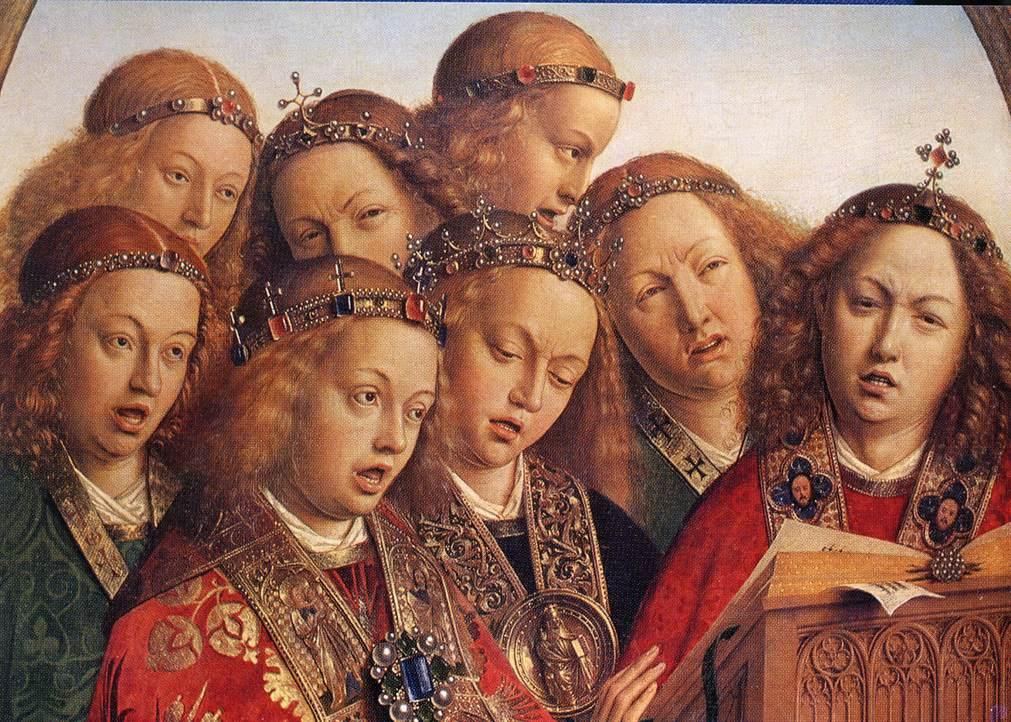
Music
An education in wonder: the tuning of the heart to what is real.
What it is
For the Greeks, music meant every art of the Muses: poetry, story, song, drama, and the visual arts, and even history and astronomy. Clark and Jain stress that what makes an education musical is not its subject but its mode. It meets the world first with delight and wonder, before analysis and critique. James S. Taylor calls this poetic knowledge: knowing a thing by encountering it, the way a child knows the sea.
Why it matters
Music trains temperance in the affections. C. S. Lewis warned that modern schooling produces “men without chests,” people with clever heads and strong appetites but no trained feelings in between. The remedy is not argument. It is a childhood filled with great stories, noble examples, and beautiful things, so that a child comes to love what is lovely before he can say why.
John Senior put the order plainly: the great ideas only take root in an imagination already rich with fables, fairy tales, rhymes, and adventures. Skip this floor, and the Great Books fall on stony ground.
Lewis, The Abolition of Man (1943), chapter 1. Senior, “The Thousand Good Books,” in The Restoration of Christian Culture (1983).
This floor is also the primer’s first answer to shrinking attention spans. A child who has been read to every day, who knows forty poems by heart, and who has sketched a sparrow from life has a mind that can rest on one thing.
What the Church teaches
The Second Vatican Council gave Gregorian chant pride of place in the Roman liturgy (Sacrosanctum Concilium 116), and the Church has long spoken of the way of beauty as a path to God. Boethius, whose music textbook shaped a thousand years of schooling, taught that there is music in the cosmos, music in the well-ordered soul, and music we sing and play. The classroom is where the third teaches the second to hear the first.
What Clark and Jain argue
For the authors, musical education is soulcraft. Plato taught in Republic III that rhythm and harmony sink deepest into the soul and make it graceful. Clark and Jain accept the insight and note that grace in the full sense is the Holy Spirit’s work. Songs, stories, and pictures go straight to the heart and make a person a friend of reason. Richard of St. Victor put it in four words, ubi amor ibi oculus: where love is, there is an eye. Those who love a thing see what is true about it.
Aristotle, Cicero, Augustine, and Burke all held that a well-tuned soul is the root of education. In Aristotle’s account, this training builds intuition, nous, the faculty that grasps first principles in morals and metaphysics. Lewis, in The Abolition of Man, adds that value judgments are responses to something real, and that we learn to make them through intuition and imagination trained early. The middle part of a person, the heart, sits between the intellect and the appetites, and music forms it.
Participation, not performance
Quinn’s insight is that musical learning is participatory. Singing a love song is not the same as being in love, but it shares in the experience. A child knows the star by looking at it and again through the rhyme about it. Nursery rhymes give the first observations and stir the wonder that powers all later study. Quinn called this education “Musical” with a capital M.
Why not call it grammar?
The authors observe that schools already do this work and then describe it as the “grammar of math” or the “grammar of history.” Chanting the states, wearing a tunic and storming Troy from a wooden horse, and reciting poems are real musical education. Calling them grammar sends teachers chasing technical refinements. The authors’ phrase for those is linguistic epicycles. Grammar stays vital, but the chief task of the early years is what Lewis called making men with chests.
Practical consequences follow. History in the early grades builds the moral imagination. Literature should awaken the imagination before it is dissected. Science should open in wonder at creation. Christopher Perrin, in the publisher’s foreword, says that kindergarten teachers are among the most deeply classical in a school, since wonder is the condition of everything that follows.
In the classroom
- Read great works aloud, slowly, over days, even when they seem a little beyond the class.
- Memorize poetry, Scripture, and songs, and recite them together.
- Sing every day: chant, hymns, folk songs, and songs that carry facts.
- Study a painting or an icon closely each week, and talk about what is seen.
- Keep nature journals: patient looking, naming, and drawing.
- Fill history with stories of saints and heroes before dates and causes.
- Use the Thousand Good Books for read-alouds and free reading.
By grade band
Read further
- James S. Taylor, Poetic Knowledge: The Recovery of Education (1998).
- John Senior, The Restoration of Christian Culture (1983).
- Vigen Guroian, Tending the Heart of Virtue (1998), on fairy tales and the moral imagination.
- C. S. Lewis, The Abolition of Man.
- Clark and Jain, “The Musical Education: Tuning hearts to the real.”
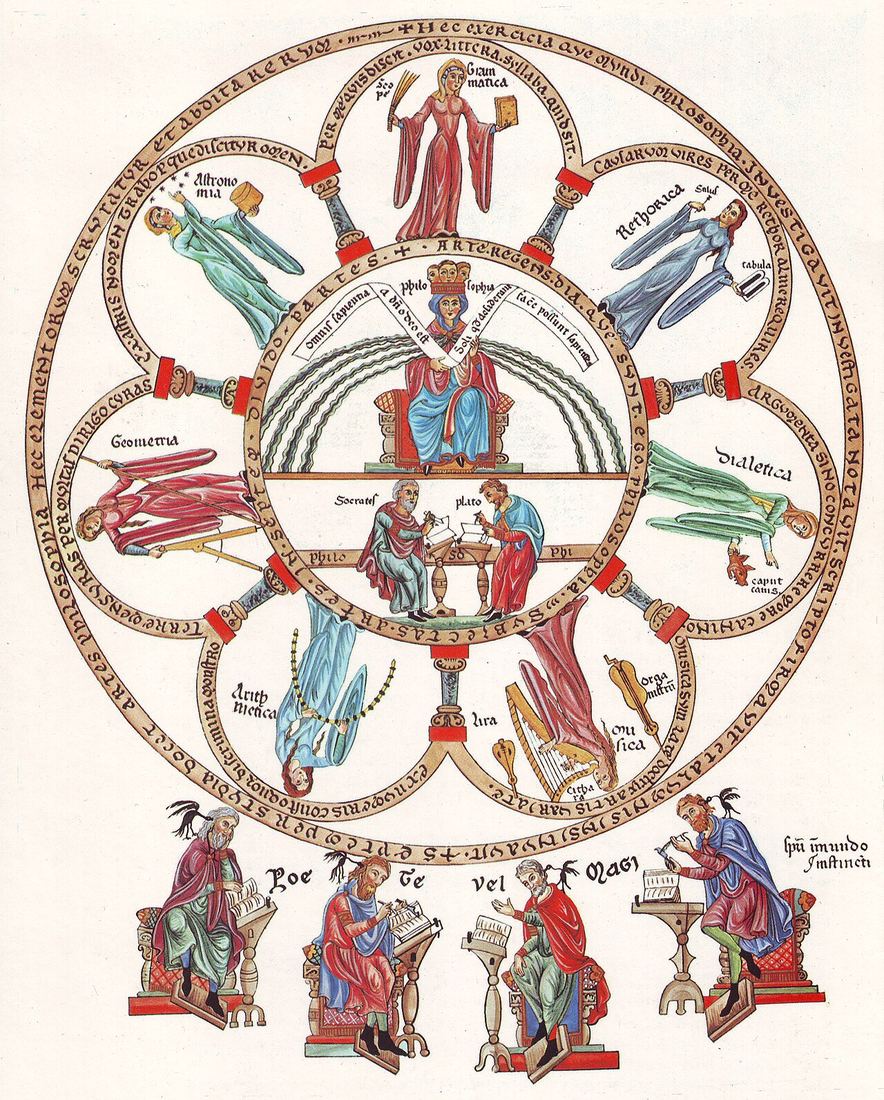
The liberal arts
Seven arts, the seeds and tools of all later learning.
What they are
An art, in the old sense, is knowledge joined to practice. In short, it is a skill. The liberal arts are the seven skills that fit a free person to discover truth and show that it is true. Three are arts of language, the trivium: grammar, dialectic, and rhetoric. Four are arts of number, the quadrivium: arithmetic, geometry, music, and astronomy.
“Liberal” comes from the Latin liber, free. These are the arts fitting for a free person, as opposed to the servile arts that serve only practical ends.
Clark and Jain call them the seeds and tools of learning. As tools, they work the soil that piety, gymnastic, and music have prepared. As seeds, they grow into the knowledge that philosophy gathers.
The trivium through three lenses
| Art | Sister Miriam Joseph | Sayers (when) | Caldecott (why) |
|---|---|---|---|
| Grammar | The art of inventing and combining symbols | The Poll-parrot age, about 9 to 11, when memory is easy and delightful | Remembering: receiving what is given, rooted in the Father |
| Dialectic | The art of thinking | The Pert age, about 12 to 14, when children love to argue | Thinking: seeking what is true, walking with the Son, the Logos |
| Rhetoric | The art of communicating thought to another mind | The Poetic age, from about 14, when students long to express | Speaking: sharing truth in communion, in the Spirit |
These lenses fit together. Sayers is right that each art has its season of greatest delight, and a school is wise to build its timetable on her insight. Caldecott is right that no art is ever left behind: a kindergartner already argues, and a senior still memorizes. Teach each art in its season, and keep all three alive at every age.
Caldecott’s publisher names the third art Communicating; his chapter calls it Speaking. The Trinitarian pairings follow his book as summarized by careful readers; consult Beauty in the Word before teaching them as settled.
The quadrivium
The arts of number were half of the old curriculum, and the modern renewal nearly forgot them. In the classical tradition handed down by Boethius, arithmetic studies number in itself, geometry number in space, music number in time, and astronomy number in space and time together. Caldecott’s Beauty for Truth’s Sake shows why this matters: mathematics studied this way is a contemplation of the order God wrote into creation, not a set of procedures to be survived.
Why it matters now
The liberal arts are the primer’s second answer to artificial intelligence. A machine can produce an essay. It cannot remember for a child, think for a child, or speak with a child’s voice. Every technique on this floor asks the student to do the work: to hold a poem in memory, to find the flaw in an argument, to stand and defend a thesis. That work is the education.
What Clark and Jain argue
Art, science, and the nexus between them
Augustine’s dialogue De Musica supplies the key image. A songbird can imitate a tune, but it has no art, because art joins imitation with reason. Clark and Jain read the liberal arts this way. They begin in imitation, where piety, gymnastic, and music have done their work, and they add reason. Aquinas names them habits ordered to works of reason: building a syllogism, composing a speech, counting, measuring. Science, in the ancient sense, is knowledge demonstrated by reason. The liberal arts, then, join discovery with demonstration.
The authors also borrow Mortimer Adler’s distinction. Episteme is the specialist’s knowledge and technique. Paideia is the generalist’s learning, an acquaintance with every branch without expertise in any. They add Aristotle’s counsel to match the precision of an argument to its subject. One may demand proof from a mathematician but not from an orator. Each art is a well-worn path. Detach a skill from its content and form, they warn, and you deface it.
The history matters too. Roman education stressed grammar and rhetoric. Varro listed nine arts, adding architecture and medicine. The combination of trivium and quadrivium comes from Cassiodorus in the sixth century and from Alcuin, so the classical liberal arts are largely a Christian synthesis of the early Middle Ages. They also correct a common misreading. Aristotle’s “rational animal” is the living being that has logos, speech, and not merely a calculator. The authors notice the echo in a God who creates by his word.
Grammar: being at home in language
- Imitation first. Children learn to speak by hearing, repeating, and memorizing rhymes, songs, prayers, and poems. Speaking comes before reading and writing. The trained ear gives an intuition that something “sounds right” before the student knows why.
- Three senses of grammar. The practical sense is speaking, hearing, reading, and writing. The metaphysical sense is perceiving the essence of things by joining them to their names. The moral sense is learning the authors, which teaches whom to trust.
- Naming through delight. Children learn the names of trees, events, and heroes in songs, stories, and feasts, not on flashcards. Comenius’s picture book Orbis Sensualium Pictus is one model.
- Analysis after embrace. Diagramming, parts of speech, and mechanics come once memory is stocked and intuition is trained. The classical method analyzes what a student has first received with sympathy.
- The “grammar of” mistake. Calling history or science “grammar” starts from the modern notion of grammar as a rule list and leaves the modern curriculum unchallenged.
- Latin and ad fontes. Latin and Greek help the mind, but the goal is the humanist cry to go to the sources. The authors warn that years of the languages alone do not produce a liberal education. Close study of first-rate texts does.
Dialectic: following the question
Logic, from Aristotle’s Organon onward, tests whether a conclusion follows. Formal logic checks the form of the argument, and material logic asks whether the premises are true. Dialectic goes further. It is the art of asking and following good questions in conversation, and its aim is less to hold answers than to learn which questions are worth the asking. Plato’s dialogues are its original textbook. At the start of the Charmides, Socrates says he inquires because he does not know, and that humility belongs to the method.
The medieval disputed question has five steps: frame a yes-or-no question, summarize the strongest arguments for the side you will later oppose, bring in an authority for the other side, argue your own position, and answer the first set of objections by showing each holds a partial truth. Aquinas’s first article in the Summa is the model, though the authors judge the full form too cumbersome for most classrooms. They prefer simpler beginnings: a yes-or-no exchange with a toddler, Latin greetings that also teach case and number, and catechism answers memorized and then discussed. A Socratic discussion should model question-asking, not steer students to an answer already chosen.
Rhetoric: creative, persuasive, productive speech
The five canons are invention, arrangement, style, memory, and delivery. The three species of speech are judicial, ceremonial, and deliberative, which turn on justice, honor, and the useful. Cicero’s three purposes are to teach, to delight, and to move. Quintilian’s ideal speaker is a good man skilled in speaking, so character comes first. Aristotle defines rhetoric as the power of seeing the available means of persuasion in a given case. That makes it an intellectual power, not a coat of paint.
The authors add a historical caution. Greek sophists leaned toward persuasion and philosophers toward truth, and the main tradition tried to join them. Later, rhetoric narrowed toward ornament until the Renaissance recovered Aristotle and Quintilian. In practice, teaching begins in the early grades with great speech read aloud and imitated. Commonplace books, paraphrase drills, and recitation follow, and then original speeches. Rhetoric opens onto questions of wisdom, which is why the trivium leads on to philosophy.
The quadrivium and its four goals
- Origins. Philolaus the Pythagorean held that whatever can be known has number. Archytas, a friend of Plato, is credited with setting the four arts as a core. His definitions: arithmetic is number at rest, geometry magnitude at rest, music number in motion, astronomy magnitude in motion.
- Not for shopkeepers. Plato wants mathematics for rulers because it lifts the mind from shifting opinion toward truth. Usefulness counts, but formation counts first.
- Arithmetic and the one and the many. Nicomachus’s old textbook treats number as relational, so a fraction is a ratio. The puzzle of unity and multitude points toward the Trinity, and Augustine finds a trace of it in memory, understanding, and will.
- Geometry means Euclid. The Elements was the geometry textbook for more than two thousand years. Constructions come before proofs, and geometry belongs before algebra. Jacob Klein argued that algebra first leaves students with a nominalist view of number. The authors admit Euclid is hard to teach well, and an experienced teacher or a supportive community helps.
- Astronomy and the debate over truth. Astronomy “saved the appearances.” Osiander’s preface to Copernicus treated models as handy fictions, while Kepler, Galileo, and Newton believed their models described real things. The authors recommend that older students study that debate.
- Music in three levels. Musica instrumentalis is audible music, musica humana is the harmony within a person and a society, and musica mundana is the harmony of the cosmos. Kepler’s Harmonices Mundi shows the third at work.
The authors balance all four arts under four goals: wonder, work, wisdom, and worship. Arnold Toynbee’s regret at skipping calculus for more Latin and Greek warns against setting languages against mathematics. They recommend puzzle, proof, and play before practice and performance.
In the classroom
The technique library lists thirty-five methods, eleven of them as fully worked lessons, sorted by art, grade, subject, time, and purpose. A short starting set:
- Grammar: catechism-style recitation, copywork and dictation, Latin paradigm chants, narration.
- Dialectic: Socratic questioning and seminar, the common topics, formal logic, disputation.
- Rhetoric: the progymnasmata, imitation of models, the six-part oration, thesis and public defense.
- Quadrivium: proofs drawn and explained aloud, the music of ratios, the night sky observed before it is calculated.
By grade band
Read further
- Dorothy L. Sayers, “The Lost Tools of Learning.” Text
- Stratford Caldecott, Beauty in the Word and Beauty for Truth’s Sake.
- Sister Miriam Joseph, C.S.C., The Trivium: The Liberal Arts of Logic, Grammar, and Rhetoric.
- Robert Littlejohn and Charles T. Evans, Wisdom and Eloquence (2006).
- Hugh of St. Victor, Didascalicon.
Philosophy
The love of wisdom, gathering everything learned into one understanding of nature, man, and being.
What it is
Philosophy here does not mean a narrow modern department. For more than two thousand years it named the unity of all knowledge, in three branches. Natural philosophy studies the world, and is the old home of today’s sciences. Moral philosophy studies human action and community, and is the old home of ethics, politics, and economics. Divine philosophy, or metaphysics, studies being itself and the first causes of all things.
Its key instrument is Aristotle’s four causes. Of anything, ask what it is made of, what it is, what made it, and what it is for. Modern science keeps the first and third questions and drops the others. A classical school asks all four, which is why a biology class can end in wonder rather than mere mechanism.
Why it matters
Without philosophy, subjects fall apart into separate piles of facts. With it, a student can see how a cell, a sonnet, a just law, and the existence of God belong to one world. Philosophy is also where students learn that faith and reason are friends.
Faith and reason are like two wings on which the human spirit rises to the contemplation of truth.St. John Paul II, Fides et Ratio (1998)
Leo XIII’s Aeterni Patris (1879) called for the renewal of Catholic education in the philosophy of St. Thomas Aquinas.
What Clark and Jain argue
Love and truth held together
The Greek word joins philia, love, to sophia, wisdom. The ancients kept together what moderns split into private feeling and public fact. A person cannot only hold wisdom. He has to love and pursue it. “Academic” comes from Plato’s Academy, where philosophy sat at the head of education, so the Western stance toward knowledge is that philosophy is for lovers.
Against the Sophists, who taught that truth is local and justice is whatever the strong want, Plato held that a transcendent reality of truth, goodness, and beauty can be known. Knowledge, in that tradition, is about truth and not about power over nature or other people. It asks for submission to what is real.
Three branches, one reality
Medieval thinkers saw reality as God the Creator, man made in his image, and the world he made. Philosophy had three branches to match: divine philosophy or metaphysics, moral philosophy, and natural philosophy. Aquinas gave them their lasting Christian shape. The scheme survived into the nineteenth century. After John Stuart Mill, “social science” began to displace moral philosophy. Adam Smith, to take one example, held a chair of moral philosophy, not economics. Natural philosophy gave way to “science” and “scientist,” words that became common around 1900.
Natural philosophy and the four causes
- Scientia. The old word means demonstrable knowledge of causes, which Aristotle set apart from mere opinion. William Wallace argues that, read this way, modern science and the philosophy of science are not essentially different. The authors suggest this reading as a way past the modern argument over what counts as science.
- The statue. Take a marble statue. The marble is its material cause. The shape is its formal cause, which was first in the sculptor’s mind. The sculptor and chisel are the efficient cause. Delighting visitors in a garden is the final cause. Since Galileo, science has kept only the material and efficient causes, now called matter, force, and energy. The authors want all four back, so that fact is not divorced from meaning.
- Laws within a covenant. The seventeenth century recast formal cause as “laws of nature,” and God became a distant watchmaker. The authors place the laws within God’s covenant with creation (Jeremiah 33:20–21). Regularity is a sign of faithful love, and Dante is right that love moves the sun and the other stars.
- Leibniz. He first dismissed formal and final causes, then concluded the scholastics were right to keep them, and his idea of living force became the concept of energy.
- An intelligible creation. Joseph Needham asked why China, so inventive, did not produce modern science. A. N. Whitehead agreed with him that belief in a rational Creator made it possible.
Two stances toward nature
The authors use Tolkien’s Elves and Orcs. The Elves make things that work with the grain of nature. The Orcs make machines that ravage it. The Inklings shared this critique, and the authors trace the change of stance partly to Francis Bacon’s image of experiment as pressing nature for her secrets. Hugh of St. Victor’s seven common arts, set beside the seven liberal arts, were technologies that worked alongside nature. For the early years the authors propose natural history in the manner of a museum. Children behold, name, and classify, as Adam did (Genesis 2:19). Natural science proper begins after students have some logic, higher math, and rhetoric.
Knowing, not just applying
Students often hold facts without justification. Ask why gravity follows an inverse-square law and they point to the textbook, which medieval thinkers ranked the weakest kind of authority. The pendulum formula shows the cost of that habit. It holds only for small swings, a weightless string, and no friction, and even the idealized motion departs from the textbook equation. The lesson is epistemic humility, not skepticism. We know reality truly but partially.
The remedy is to retrace discovery. Students read primary sources, rebuild classic experiments such as Pascal’s vacuum experiment, and see the story as a technical narrative of discovery. Jain’s own upper-level classes read Galileo, Kepler, Newton, and Leibniz, and end with Einstein’s 1905 paper. They add Kuhn’s observation that science education produces competent technicians but not the rare mind that finds a new approach, so creativity should be nurtured alongside rigor. They reject “slave physics,” in which one computes answers without knowing why they work. They also warn that a school should not let the Advanced Placement program set its philosophy.
Moral philosophy and the inversion
- Lewis’s inversion. The wise of old sought to bring the soul into line with reality. Modern technique seeks to bend reality to human wishes.
- Social science grew from moral philosophy. Its practitioners often study isolated parts of the person. The goals of power, therapy, and management follow from Bacon’s equation of knowledge with power. MacIntyre’s figures of the manager and the therapist treat ends as given and so cannot debate them. He also argues that the social sciences have found almost no law-like generalizations, and their experts claim more control than they have.
- Virtue and happiness. Plato’s just man is happy even when he suffers. Aristotle says happiness needs some external goods. The Christian answer rests virtue on participation in Christ. Gregory of Nyssa teaches it, and Augustine adds that true virtue needs true piety. The end is beholding God, the beatific vision, which resembles Aristotle’s eudaimonia more than it contradicts it.
- The anthropological question. Before asking how to run a business, a government, or a family, moral philosophy asks what it means to be human. Theology must govern moral philosophy in a Christian school.
- A warning. Rousseau thought a lawgiver must be able to change human nature, and Nisbet and Dawson trace how bureaucracy and technique fill the gap left by lost virtue. Christian schools must not shrink into vocational training.
Moral philosophy and history
The Greek historia means inquiry. As natural philosophy needs natural history, the authors argue, moral philosophy needs history as the counterpart of moral science. They note with concern that some disciplines have dropped their own history, so students meet past theories only through a modern school. Christopher Dawson held that sociology and history are two parts of one science of social life. An economist’s analogy makes the cost plain. Relying on Adam Smith’s economics alone is like solving for four unknowns with two equations, and the debate never ends. Tracing how views of man have changed supplies the missing ones. The authors favor omnibus courses that study history, literature, politics, economics, and philosophy together in one period.
Eight marks of a Christian moral science
- An economy is an organic outgrowth of a society’s traditions and relationships, not an experiment.
- Persons are loving and communal, not only self-interested maximizers.
- Because of sin, no government should be trusted to build utopia.
- Liberty is real, but autonomy is not the final goal, since person and community shape each other.
- Freedom is sought within churches and real communities, joined to responsibility.
- Time, place, institutions, and relationships are taken seriously.
- Politics is not cut off from economics, and the parts are held within the whole of knowledge.
- Facts and values are not divorced, and technology is tied to a society’s purposes.
The authors work the same logic out in other fields. They hold that business can be a school of virtue, since contracts teach justice and love and profit signals service. They recover subsidiarity, which Catholic readers know, and Kuyper’s idea of distinct spheres of authority, so that individual and state do not stand alone. They read Augustine’s two cities as a way to see Christ as the one true sovereign, and they prefer principled pluralism to the removal of religion from public life. A realistic view of sin explains limited government and the separation of powers, and natural law binds rulers as well as subjects.
Divine philosophy
- The transcendentals. Metaphysics asks what is true of everything that is. The medieval answer was being, unity, goodness, and truth, and many add beauty. Maritain and Gilson helped revive that claim. If the list holds, every creature reflects goodness and unity in some measure.
- Why nominalism matters. Ockham denied real universals. Hume reduced causality to habit, and instrumentalists treat theories as tools. Each weakens science as knowledge of causes and leaves open the question of what a man is.
- Guardian of the secret questions. Metaphysics protects the shared meaning of words. If a judge and a defendant cannot mean the same by a word, a culture cannot reason together.
- Participation. The fathers and medievals sought to be mastered by truth, not to master it. Created things share sacramentally in Christ’s mystery, and the mundane can take part in the divine.
- Grace perfects nature. The authors point out that some Reformed thinkers, such as Vermigli and Bavinck, held the same principle. Because God does not displace the natural order, science and faith are not rivals.
- The mark of the Maker. Pascal called nature an image of grace. Augustine saw traces of the Trinity in creation. Metaphysics lets students ask how Christ holds one and many, quantity and quality, together.
- Realism. Being comes before knowing. The authors call Gilson’s reading of Aquinas the most natural home for the model, and they accept other realisms that fit. They want the school to join the perennial philosophy that kept all four causes. Metaphysics is the capstone, and natural and moral philosophy shape it in turn.
In the classroom
- Socratic seminars on primary texts, with the teacher speaking little and asking well.
- Scholastic disputation: objections first, then an answer, then replies.
- The four causes applied in the science lab and the literature class alike.
- Plato’s dialogues, Aristotle’s Ethics, and Boethius’s Consolation of Philosophy.
- Leisure in Josef Pieper’s sense: unhurried time to contemplate what is studied.
By grade band
Read further
- Josef Pieper, Leisure: The Basis of Culture.
- Boethius, The Consolation of Philosophy.
- Peter Kreeft, Socratic Logic.
- St. John Paul II, Fides et Ratio. Free text
- Clark and Jain, Part III: “Philosophy, the Love of Wisdom.”
Theology
The queen of the sciences, and a servant queen: studied last, governing from the first.
What it is
Theology is the study of God and all things in relation to Him, drawn from revelation as the Church has handed it down. St. Thomas opens the Summa by asking whether we need any teaching beyond philosophy, and answers yes: we are made for an end that reason alone cannot see. Theology crowns the tower because it knows where the whole building is going.
Clark and Jain describe her as a servant queen. Theology does not barge into the lower subjects from outside. It nourishes them from within, so that each discipline can explore the artistry of a creative God on its own terms. The principle beneath this is St. Thomas’s: grace does not destroy nature but perfects it.
Aquinas, Summa Theologiae I, q. 1, a. 1 (the need for revealed teaching) and a. 8, ad 2 (grace perfects nature). Dorothy Sayers agreed, calling theology the mistress-science without which education lacks its final synthesis.
Why it matters
Remove theology and the circle of knowledge breaks, St. John Henry Newman warned; other subjects rush in to fill the empty place and are distorted by it. St. Bonaventure showed the other side: every art, rightly followed, leads back to God. A student who sees this does not experience faith as one subject among many. He sees it as the light by which every subject is seen.
What Clark and Jain argue
The authors define theology as the science of divine revelation, with Scripture and Christ at its center, received within the living church. Aquinas’s opening move in the Summa is their starting point: beside the knowledge human reason builds, there is knowledge God gives. Scripture tells of creation, the fall, and redemption, and the classical world, however wise, had no art or science for those things. Christian thought needs one.
They observe that Christian schools nearly always make room for theology, but from an intuition that it matters rather than a clear view of its place. Three approaches are common: separate courses, theology woven through other subjects, and theology lived in prayer and worship. Each captures a real part of the truth. None yet equals the queen of the sciences that the tradition describes. The authors add Mark Noll’s observation that American seminaries, standing apart from other learning, taught theology as a thing cut off from everything else.
Why she governs
- She grounds the lower floors. Theology gives piety its object, the body its dignity as a bearer of God’s image, and music its stories, poems, prayers, and songs.
- She supplies unity. The idea that all things hang together comes from creation. Alasdair MacIntyre argues that philosophy cannot be understood apart from God.
- She supplies presuppositions. Natural philosophy borrows the ideas of creation and contingency. Moral philosophy borrows the idea that a human being is a person.
- She gives history a shape. Revelation has the form of a story. Without it, events allow endless readings.
- She is the end. Aristotle taught that the end of a thing is what matters most. Theology is the telos of the curriculum as well as its crown.
Two principles hold the structure together. Anselm’s credo ut intelligam says faith opens the road to understanding, and Scripture is read rightly in submission to Christ, within the people of God and beside the Church’s living Tradition. And because revealed truth will not contradict natural truth, natural theology and metaphysics are possible, and grace perfects nature.
The marks of a Catholic school
Archbishop J. Michael Miller named five marks by which a school can ask whether it is truly Catholic:
- Inspired by a supernatural vision
- Founded on a Christian anthropology
- Animated by communion and community
- Imbued with a Catholic worldview throughout its curriculum
- Sustained by Gospel witness
The six floors are a way of building all five into the life of a school. The Front Royal Statement’s seven principles run in the same direction and give a board a second checklist; see the statement.
In the classroom
- Scripture read daily, and the Catechism learned well.
- History, literature, and theology studied in the same era, so faith is met inside culture.
- In high school, short articles of the Summa read and disputed in their own form.
- Church documents read from the source, not only in summary.
- The great arc of exitus et reditus: all things come from God and return to Him.
By grade band
Read further
- Archbishop J. Michael Miller, The Holy See’s Teaching on Catholic Schools (2006). The five marks
- St. Bonaventure, On the Reduction of the Arts to Theology.
- St. John Henry Newman, The Idea of a University. Free text
- Congregation for Catholic Education, The Catholic School (1977) and The Religious Dimension of Education in a Catholic School (1988).
Mission and motto
A mission says what a school is for. A motto says what it loves. Both should be short enough for a seven-year-old to say and deep enough for a board to argue over.
A mission in one sentence
Our school assists parents in forming their children to know, love, and serve Jesus Christ through an extraordinary Catholic, classical education.
Each phrase carries weight.
- Assists parents. The Church teaches that parents are the first and principal educators of their children. A school that forgets this slowly becomes a service provider; a school that remembers it becomes a partner.
- Forming. Not only informing. The whole child is in view: body, heart, mind, and soul.
- To know, love, and serve. Generations of Catholic children learned from the Baltimore Catechism that God made them to know Him, to love Him, and to serve Him in this world, and to be happy with Him forever in the next. A mission that echoes this answer tells every family what the school thinks a human life is for.
- Catholic, classical. The two words together, in that order: the faith gives the education its purpose, and the classical tradition gives the faith its school.
Why a motto matters
A motto is the mission compressed into a phrase a community can carry. It appears on the crest, opens the assembly, ends the newsletter, and is said by graduates years later without thinking. Families choose schools whose identity they can name and trust; benefactors give to them; teachers want to work in them. A clear motto is one of the cheapest and most durable ways to build that trust.
An example: St. Ambrose Academy
St. Ambrose Academy in Madison, Wisconsin, takes its motto from its patron: Omnia Christus est nobis, “Christ is everything for us.” The line comes from St. Ambrose of Milan’s treatise on virginity, where he lists what Christ is for those who need Him: the physician for the wounded, the spring for the feverish, strength for the weak, life for those who fear death. Pope Benedict XVI closed a 2007 general audience on Ambrose with the same passage.
The school’s crest tells the same story in pictures: a bishop’s miter for Ambrose and the teaching Church, bee wings for the “honey-tongued doctor” whose preaching helped convert St. Augustine, a cross, and a fleur-de-lis for the Trinity and Our Lady. Its mission is to assist parents in the formation of their children by providing a classical education rooted in the Catholic faith. See the full case study.
Ambrose, De virginitate 16.99. Benedict XVI, General Audience, 24 October 2007.
Other mottos worth knowing
- Cor ad cor loquitur, heart speaks to heart. St. John Henry Newman’s motto, and a fine summary of how formation actually happens.
- Nascantur in admiratione, let them be born in wonder. The motto of John Senior’s Integrated Humanities Program at the University of Kansas.
Parents as primary educators
This is not a slogan but settled Church teaching. The Second Vatican Council called parents the primary and principal educators of their children (Gravissimum Educationis 3). The Catechism teaches that parents have the first responsibility for their children’s education (2223). Canon law gives Catholic parents both the duty and the right to choose a school that will truly form their children in the faith (canon 793). The Front Royal Statement adds a pointed question: a freedom that families cannot afford is no freedom at all. See principle 3.
In practice, a classical school honors this by inviting parents into the curriculum itself: parent seminars on the books their children read, take-home recitation, family feast days, and a shared agreement about phones and media at home.
A checklist for your mission
- Can every teacher say it from memory?
- Does it name Christ, not only “values”?
- Does it name the parents’ role?
- Would a stranger know what kind of school this is after hearing it once?
- Could the board use it to decide a hard budget question?
Sources
- St. Ambrose Academy, Our Mission and Our New Look.
- Benedict XVI, General Audience on St. Ambrose, 24 October 2007.
- Second Vatican Council, Gravissimum Educationis.
The Front Royal Statement
Seven cardinal principles for Catholic primary and secondary education, written by bishops and educational leaders who share one conviction: the Church already has a philosophy of education, and it is time to use it.
What it is
The statement came out of the Front Royal Education Summit, two days of discussion at Christendom College in Front Royal, Virginia. Bishops, diocesan superintendents, college and university scholars, school leaders, and strategic partners took part. About forty attendees signed it, among them five bishops and archbishops. Bishop James D. Conley of Lincoln wrote the introduction, and Bishop Thomas A. Daly of Spokane contributed words that close the preamble.
Its stated aim is modest and large at once. It hopes to give the many streams of renewal in Catholic schools “a shared foundation,” so that classical schools, diocesan systems, and teacher-formation programs can speak the same language about what a Catholic school is for. The text gives no calendar date. Its preamble opens “one hundred forty-two years ago” from the Third Plenary Council of Baltimore, which met in 1884, so it belongs to 2026.
This page paraphrases the statement and quotes it only in short phrases. Read the full text, which is brief, before you bring it to a board or a faculty. No web address for it appears in the copy we worked from, so we have not linked one.
The diagnosis
The preamble tells a story in two parts. In 1884 the bishops, meeting in Baltimore, resolved to build a Catholic school in every parish. Public schools of the day were steeped in Protestant culture and, the statement says, were founded partly to suppress the faith of Catholic immigrants. The Church answered decisively. Catholic schools grew from roughly 1,400 in 1874 to 2,500 in just under a decade, and reached nearly 13,000 by 1960, with over five million students.
Then the long decline. For sixty years, an average of 100 schools has closed each year. Only 6,000 remain, serving fewer than 1.7 million students, even though the Catholic population has grown. The preamble names the causes it sees: young Catholics leaving the Church amid a culture of skepticism and materialism, falling enrollment, rising costs, too few well-formed teachers and leaders, some pastors unwilling to keep schools open, and families who want a Catholic education and cannot afford one.
Its warning is blunt. If the trend runs another sixty years, Catholic schooling will survive mostly in homeschools and small co-ops. Its remedy is just as plain. Do not chase secular models or accommodate “failed modern pedagogies.” Return to the Church’s own philosophy of education, and ask again what the curriculum, the pedagogy, and the culture of a school are for.
The seven cardinal principles
The principles move in a clear order. The first two say what education is for and who the child is. The third and fourth say who holds authority over a school. The fifth and sixth say who teaches and what is taught. The seventh says what air the child breathes.
1. The supernatural end of education
Education is ordered to God and forms the whole child. It begins by respecting nature, because “grace builds upon nature and brings it to its fullest perfection.” It is medicinal, healing the wounds of sin and training the intellect and the will together. Its final end is the Beatific Vision, and its fruits are worship, holiness, wisdom, and contemplation.
What it asks of a school
- Name heaven, not college admission, as the end of the school’s work, and say so in the mission.
- Treat discipline as the strengthening of the will, not as the management of behavior.
- Judge every program by whether it forms desire to love what is truly good.
- Keep the sacraments and worship near the center of school life.
2. The nature and dignity of the human person
Every child is made in God’s image, with reason and freedom, body and spirit. The educator’s task is “to recognize the image of God in each child.” Persons are relational, made for communion. They are also wounded by original sin, so growth in virtue is real work that grace makes possible. The cardinal virtues perfect our faculties, and rightly ordered love completes them.
What it asks of a school
- Educate the body, the heart, and the mind, not the intellect alone.
- Build a culture of correction and mercy that takes both dignity and sin seriously.
- Honor the dignity of every student regardless of ability, rank, or behavior.
- Teach the virtues by name, and practice them daily.
3. What children deserve, the rights of parents, and the duties of the State
Children deserve an education that aims at flourishing and the learning of virtue, not only at economic usefulness. Parents are the primary educators and have the right to direct their children’s schooling by their own religious and moral convictions. The statement adds a hard edge: “A freedom constrained by financial impossibility is not genuine freedom, but privilege reserved for the few.” It calls on the State to support educational choice as a recognition of a prior right, not as a favor.
What it asks of a school
- Treat parents as partners in the curriculum, with seminars, shared expectations, and honest communication.
- Review tuition, aid, and fundraising with this question in view: can a family who wants us afford us?
- Support parents with adult formation, not only with newsletters.
- Inform families about educational choice programs in your state and help them use them.
4. The ecclesial responsibility of bishops and priests
Bishops and priests are fathers and shepherds of the school community. The statement cites canon law for their duty to ensure that the faithful receive an authentically Catholic education, and for the bishop’s oversight of Catholic identity. It asks priests to teach, to foster parents as first educators, and to promote adult catechesis. It also warns against treating “Catholic identity” as a separate department. Oversight reaches the whole academic program. Teachers and leaders owe due obedience to the pastor, and independent schools should stay close to their bishop. The aim is a school that is “a genuine extension of the Church’s educational mission rather than a detached, independent entity.”
What it asks of a school
- Give the pastor and bishop a real place in the life of the school, not a ceremonial one.
- Invite the pastor to teach, to hear confessions, to celebrate Mass, and to know the students.
- Decide who is responsible for adult formation of parents, and put it on the calendar.
- If your school is independent, write down how it stays in communion with the local Church.
5. The formation and responsibilities of teachers and leaders
Teachers and leaders are witnesses as well as instructors. The statement holds that “true academic excellence is fully compatible with doctrinal fidelity and spiritual vitality.” Formation has three dimensions: intellectual, in doctrine and the liberal arts; spiritual, in prayer and the sacraments; and pedagogical, using mimetic, dialectical, and direct methods as each is fitting. Leaders must model all three and have the courage to require them. The statement also says that this formation should never be subordinated to secular licensure, certification, or accreditation frameworks.
What it asks of a school
- Plan faculty formation across all three dimensions, with time set aside for each.
- Hire for love of learning and love of the faith, and train for the rest.
- Give teachers a Catholic liberal education of their own, by reading, seminar, and study.
- Treat outside credentials as useful tools, and measure the school’s formation by its own aims.
6. The integrity and order of the curriculum
A curriculum is “a path,” an ordered plan of study. The statement places the liberal arts at its core and then names the rest: mathematics, history, science, literature and philosophy, the foundational texts of the Western tradition, great music and art, and theology as the integrating discipline. Christ the Logos stands at the center. Imagination is filled with the true, the good, and the beautiful, and from it rises discovery and then wisdom. “The aim of Catholic education is not merely to communicate facts but reality itself.” The statement rejects scientific materialism, historicism, relativism, and any false neutrality in the disciplines.
What it asks of a school
- Publish a scope and sequence that shows how the subjects relate and where theology governs.
- Teach history, literature, and theology through the same era together.
- Keep chant, sacred art, and the great composers in the core, not in the electives.
- Audit textbooks and course materials for hidden materialism or relativism.
7. The transmission of a living Catholic culture
Culture is a living inheritance, received and handed on, not built by committee. It is the home in which persons grow. The Church is its fullest form, and her worship, her cultus, is its heart. The statement asks Catholics to seek the full development of their culture, which includes the classics and “the best that has been thought and said.” “A truly Catholic education is an enculturation into the mind of the Church.” Schools are civilizational institutions, and they carry the culture or they lose it.
What it asks of a school
- Shape the week and the year by the liturgy: feasts, seasons, Mass, and the Hours.
- Fill the building with images, music, and customs that belong to the Church.
- Keep the traditions of the school stable enough for graduates to recognize and pass on.
- Teach the classics as an inheritance to love, not as a canon to survey.
Where each principle lives on this site
The statement and the primer’s six floors were written separately and arrive at the same house. This table shows where each principle is developed here.
| Principle | Floors | Pages |
|---|---|---|
| 1. The supernatural end | VI. Theology, I. Piety | The model, Mission and motto |
| 2. The human person | I. Piety, II. Gymnastic, III. Music | The model, Thinkers |
| 3. Children, parents, and the State | I. Piety | Mission and motto, Side by side, Renewing a whole school |
| 4. Bishops and priests | VI. Theology, I. Piety | Renewing a whole school, Case studies |
| 5. Teachers and leaders | I. Piety, IV. Liberal arts, VI. Theology | Technique library, Renewing a whole school |
| 6. The curriculum | IV. Liberal arts, V. Philosophy, VI. Theology | Scope and sequence, Good books and great books |
| 7. A living culture | I. Piety, III. Music | Good books and great books, Phones, AI, and attention |
The statement says little about gymnastic, and nothing explicit about phones or screens. Those pages go beyond it. It speaks of the body mainly in its account of the whole person, and the primer takes that seriously by giving the body its own floor.
Using it in your school
- Faculty study. Read one principle a month at faculty meeting, with the statement’s own text on the table. Ask each teacher to name one thing in their classroom that this principle explains or challenges.
- Board adoption. Have the board receive the statement, discuss it, and adopt it, or an adapted version, as a guiding charter. Pair the vote with the board’s own study of the principles.
- Mission review. Hold your mission and motto beside principles 1 and 7. Does the mission name the end of education, and does the school’s daily life carry a culture?
- Accreditation and self-study. Use the questions below as a supplement to your regular self-study. Principle 5 invites schools to measure Catholic formation by Catholic aims, so record your answers alongside the standard report.
- Parent evenings. Offer the third principle to families in plain words. Many have never been told that they are the first educators.
Seven self-study questions
- End. Can every teacher say, in one sentence, what the school is ultimately for, and does that sentence mention God?
- Person. Where in the week do students receive formation of the body and the heart, not only the mind?
- Parents. What do we ask of parents besides tuition, and what do we offer them besides reports?
- Church. When did our pastor or bishop last shape something in the school, and when did we last ask?
- Teachers. What formation plan, intellectual, spiritual, and pedagogical, does each teacher have for this year?
- Curriculum. Can we show where theology orders the other subjects, and where a subject quietly assumes the opposite?
- Culture. If a visitor walked the halls on an ordinary Tuesday, what would the building, the calendar, and the music tell them about the Church?
Sources
- The Front Royal Statement: Seven Cardinal Principles of Catholic Primary and Secondary Education, issued from the Front Royal Education Summit at Christendom College. Introduction by Bishop James D. Conley. We worked from the full text supplied to the editor and found no web address in it.
- Pius XI, Divini Illius Magistri (1929), cited in the introduction and in principle 1.
- Second Vatican Council, Gravissimum Educationis (1965), cited in principles 1 and 3.
- Second Vatican Council, Gaudium et Spes (1965), cited in principle 7.
- Leo XIV, Drawing New Maps of Hope (27 October 2025), cited in principle 3. Congregation for the Clergy, General Directory for Catechesis (1997), cited in principle 4. Code of Canon Law, canons 773 to 776, 794, and 804 to 806, cited in principle 4.
Scope and sequence
A suggested shape for a K4–12 Catholic classical school, built floor by floor. Adapt it; do not copy it.
| K4 to 2 | 3 to 5 | 6 to 8 | 9 to 12 | |
|---|---|---|---|---|
| Piety | Atrium, prayers by heart, saints’ stories | Mass, Rosary, catechism recitation | Examen, service, mentoring | Hours, Adoration, vocation |
| Gymnastic | Free play outdoors, letter formation | Cursive, games with rules, crafts | Team sport, drama, endurance | Athletic discipline, oratorical presence |
| Music | Rhymes, fairy tales, chant, nature walks | Myths, poems by heart, picture study, choir | Epic, Shakespeare performed, sketching | Poetry as art, great novels, choral singing |
| Trivium | Phonics, narration, recitation | English and Latin grammar, dictation, timelines | Formal logic, seminar, early progymnasmata | Rhetoric, oration, senior thesis |
| Quadrivium | Counting, shapes, pattern | Math facts, measurement, the night sky | Euclid, ratio and music, pre-algebra and algebra | Proof, calculus, physics from primary sources |
| Philosophy | Wonder and “why” questions | Aesop’s morals, nature study | Plato’s shorter dialogues, the four causes | Aristotle, Aquinas, Boethius, Pieper |
| Theology | The Good Shepherd, Bible stories | Salvation history, sacraments | The Creed and its reasons | Scripture, Fathers, Summa, social teaching |
The integrated cycle
The most recognizable feature of a classical curriculum is that history, literature, theology, and the arts move through the same era together. A student reading the Aeneid in English class is studying Rome in history, meeting the early Church in theology, and looking at Roman architecture in art. Knowledge stops being a pile of subjects and becomes one story.
Schools do this in two common ways. St. Jerome Academy, a K–8 parish school, takes students through the history of the world twice, once in the lower grades and again in the upper grades. St. Ambrose Academy, a 6–12 school, teaches its high school humanities in four cycles: the ancient world, the medieval and Renaissance world, America, and the modern world. Each cycle has its own Thomistic readings, and the theology course for the American cycle is organized around the great movement of exitus et reditus, creation going out from God and returning to Him.
A few principles
- Latin early. Begin by grade 3, with Latin prayers and songs even earlier. Sayers argued that even a little Latin halves the labor of learning almost anything else.
- Mathematics as contemplation. Manipulatives before symbols, proofs explained aloud, pattern noticed across subjects.
- Science as natural philosophy. Observe and name before you dissect and calculate. Ask all four causes.
- Good books before great books. See Good books and great books.
- Not many things, but much. Fewer texts, read slowly and well, beat a crowded syllabus.
What Clark and Jain add on practice
The last part of the book offers short notes on pedagogy. Its first principle is wonder. The authors say a teacher’s task is to turn students toward the goodness, truth, and beauty of the things themselves: nature, language, number, history, and God. That frees a school from gadgets and tricks. Two old mottos set the pace, non multa sed multum and festina lente, which mean not many things but much, and make haste slowly.
- Wonder and the things themselves. Read aloud, copy, memorize, and narrate, so that students meet language directly. Sketch nature outdoors before using instruments.
- Ad fontes. Return to the sources as a long-term aim. Translations are valuable but cannot show the author’s face, so schools keep Greek and Latin alive to protect the integrity of grammar, dialectic, and rhetoric.
- Interdisciplinary teaching. Literature, mathematics, philosophy, and history help science integrate what it knows. Theology governs the whole.
- Narrative and canon. Choose readings as episodes in one story, creation, fall, redemption, and consummation, not as a list of famous books. Ask where the student fits in the story.
- Real but peripheral practice. Let students take part in a feast of what is true, good, and beautiful, at a level fitted to them.
The book’s checklists
The appendix gives four checklists that a school can adapt. A curriculum committee tests a reading list: is the load light enough to read deeply, which books are mandatory and which optional, what works as a read-aloud, and do classics outnumber recent titles? It also asks the committee to review the list every year or two. An administrator preparing public remarks repeats the mission, tells a school story, invites a witness, features students, and stresses one element of the liberal arts. A parent meeting begins with what the child does well, names the partnership, asks what parents see at home, and puts virtue before grades. A report card de-emphasizes numbers, includes a virtue section and a brief teacher narrative, and uses a rubric that avoids familiar letter grades. For a full guide to the book, see Inside the book.
Good books and great books
The great books are seeds. The good books are the soil. Plant the seeds in soil that has never been tilled, and almost nothing grows.
The good books
John Senior, who taught at the University of Kansas and led one of the most fruitful humanities programs in modern Catholic life, observed that the Great Books movement did not fail because the books were bad. It fizzled because students came to Plato and Aquinas with imaginations that had never been fed. The great ideas only grow in a mind already saturated with fables, fairy tales, rhymes, and adventure stories.
So Senior drew up a list of a thousand good books, arranged by the ages of life, as preparation for the great ones. He meant it as a worksheet, not a canon, and he insisted the point of view was the amateur’s: the ordinary reader who loves what he reads. Clark and Jain reprint his list as an appendix to The Liberal Arts Tradition.
Senior also urged editions illustrated by the great artists of the golden age of book illustration: Randolph Caldecott, Kate Greenaway, Walter Crane, Arthur Rackham, Howard Pyle, N. C. Wyeth, Beatrix Potter, and Sir John Tenniel.
The nursery, ages 2 to 7
- Aesop’s Fables
- Mother Goose
- Grimm’s Household Stories
- Hans Christian Andersen, Fairy Tales
- Andrew Lang, the colored Fairy Books
- Beatrix Potter, the little books
- Robert Louis Stevenson, A Child’s Garden of Verses
- A. A. Milne, Winnie-the-Pooh
- Kenneth Grahame, The Wind in the Willows
- Rudyard Kipling, Just So Stories
- Carlo Collodi, Pinocchio
- Lewis Carroll, the Alice books
School days, ages 7 to 12
- Daniel Defoe, Robinson Crusoe
- Johann Wyss, Swiss Family Robinson
- Robert Louis Stevenson, Treasure Island
- Howard Pyle, Robin Hood
- Johanna Spyri, Heidi
- Louisa May Alcott, Little Women
- Anna Sewell, Black Beauty
- Laura Ingalls Wilder, Little House on the Prairie
- Mark Twain, Tom Sawyer
- Charles Dickens, A Christmas Carol
- Frances Hodgson Burnett, The Secret Garden
- Jules Verne, Around the World in Eighty Days
- C. S. Lewis, The Chronicles of Narnia
- J. R. R. Tolkien, The Hobbit
Adolescence, ages 12 to 16
- Walter Scott, Ivanhoe
- Alexandre Dumas, The Three Musketeers
- Victor Hugo, Les Misérables
- Henryk Sienkiewicz, Quo Vadis
- Arthur Conan Doyle, Sherlock Holmes
- Jonathan Swift, Gulliver’s Travels
- Mary Shelley, Frankenstein
- Charles Reade, The Cloister and the Hearth
- Shakespeare, A Midsummer Night’s Dream
- Marco Polo, Travels
- Francis Parkman, The Oregon Trail
- Thomas Hughes, Tom Brown’s School Days
- J. R. R. Tolkien, The Lord of the Rings
Youth, ages 16 to 20
- Jane Austen, Pride and Prejudice
- Charlotte Brontë, Jane Eyre
- Alessandro Manzoni, The Betrothed
- Georges Bernanos, The Diary of a Country Priest
- Willa Cather, Death Comes for the Archbishop
- G. K. Chesterton, Father Brown and The Everlasting Man
- Fyodor Dostoevsky, The Brothers Karamazov
- Sigrid Undset, Kristin Lavransdatter
- Herman Melville, Moby-Dick
- Leo Tolstoy, War and Peace
- Charles Dickens, Bleak House
- Shakespeare, Hamlet and Macbeth
- C. S. Lewis, the Space Trilogy: Out of the Silent Planet, Perelandra, That Hideous Strength
For all ages, Senior placed the Bible first, recommending the Douay-Rheims for Catholics, with St. Francis de Sales’s Introduction to the Devout Life. He added a short course in listening to music, one work at a time, and visits to museums.
The great books
The great books are the long conversation of the West about the questions that never go away. What is justice? What is love? What is a good life? What happens when we die? Read in order, they form a single argument across three thousand years, and the Church has been part of that argument from the beginning.
Underneath all the questions is one question. What is a human life for? Achilles seeks glory and finds grief. Aeneas carries his father out of burning Troy and gives up his own desires for a city he will never see. Socrates gives his life rather than betray the truth. Augustine discovers that his restless heart was made for God. Dante’s pilgrim climbs until he is moved by the love that moves the sun and the other stars.
The Church gives the answer these books are reaching for.
Man, who is the only creature on earth which God willed for itself, cannot fully find himself except through a sincere gift of himself.Second Vatican Council, Gaudium et Spes 24
St. John Paul II returned to this sentence again and again, from his catechesis on the human body to his 1994 Letter to Families. In his first encyclical he put the same truth in its most personal form: a human being cannot live without love, and his life is senseless unless love is revealed to him and he makes it his own.
John Paul II, Redemptor Hominis 10 (1979). He paired Gaudium et Spes 24 with section 22: only in the mystery of the Word made flesh does the mystery of man become clear.
This is why the great books belong in a Catholic school. They show, with every kind of beauty and every kind of tragedy, that a life grasped for oneself is lost and a life given away is found. A student who has watched Aeneas, Antigone, Augustine, Dante, Sydney Carton, and Alyosha Karamazov wrestle with that truth is ready to hear the Gospel say it plainly.
The ancient world
What is greatness? What is justice? What do we owe the gods, our fathers, and our city?
Homer, Iliad and Odyssey. Sophocles, Antigone and Oedipus. Herodotus and Thucydides. Plato, Apology and Republic. Aristotle, Nicomachean Ethics. Virgil, Aeneid. Plutarch, Lives. Genesis and Exodus.
The medieval world
What do we love, and in what order?
Augustine, Confessions and City of God. Boethius, The Consolation of Philosophy. The Rule of St. Benedict. Beowulf. The Song of Roland. Aquinas, selected articles of the Summa. Dante, The Divine Comedy. Chaucer, The Canterbury Tales.
The early modern and American world
What is freedom for? What makes a people able to govern itself?
Shakespeare, the tragedies and histories. Cervantes, Don Quixote. Pascal, Pensées. The Declaration of Independence, the Constitution, and The Federalist. Tocqueville, Democracy in America. Hawthorne, Twain, Lincoln, and Flannery O’Connor.
The modern world
What happens to man when he forgets God, and how does he find his way home?
Dickens, A Tale of Two Cities. Dostoevsky, The Brothers Karamazov. Newman, The Idea of a University. Leo XIII, Rerum Novarum. Chesterton, Orthodoxy. C. S. Lewis, The Abolition of Man. Solzhenitsyn, One Day in the Life of Ivan Denisovich. T. S. Eliot, Four Quartets.
A practical model: the book’s own reading lists
Clark and Jain close with sample reading lists from early years through twelfth grade. They present them as examples to adapt, not a canon to copy, and they urge every school to build its own list from its community, priorities, and philosophy of education. What the lists model is more useful than the titles. Each entry carries a code for how it is read: T when the teacher reads aloud, R when students read alone, RA when students read aloud, and RT when both do. Fifth-grade entries add percentage splits among the modes. From seventh grade the lists separate books read completely, books read in excerpts, and summer reading. The upper lists often pair a classic with a text that challenges it, and they set a recent novel beside older works. A curriculum committee can borrow the codes, the pairings, and the review questions. See Inside the book for the checklists.
The sample lists use a Protestant Bible translation. A Catholic school would substitute its approved text.
Sources
- John Senior, “The Thousand Good Books,” in The Restoration of Christian Culture (1983).
- Second Vatican Council, Gaudium et Spes, 22 and 24.
- John Paul II, Redemptor Hominis, 10.
Technique library
Thirty-five classical methods, eleven of them worked out as complete lessons you can teach tomorrow.
The techniques are organized by the three arts of the trivium. Grammar techniques help students know and remember. Logic techniques help them understand and reason. Rhetoric techniques help them express and persuade. Begin with the foundations, which underlie all of them.
Foundations
These are the core practices every classical teacher should use, in every subject and at every grade. Learn them first. The library below holds the rest.
1. The mimetic lesson
Teaching by imitation of models, the oldest method there is. It works because people learn what is good by seeing it done well.
- Preparation. Settle attention and awaken wonder toward what will be learned.
- Presentation of types. Set two or three excellent examples before the class: sentences, proofs, documents, paintings.
- Comparison. Ask questions until students see what the examples share, and how they differ from non-examples.
- Expression. Students state the principle in their own words, only after they have seen it.
- Application. Students practice the form in fresh work until it becomes second nature.
Related: Imitating Lincoln’s opening sentence, Imitation of models.
2. Socratic teaching
The teacher draws out what the student already half knows by asking questions, instead of telling. Socrates compared this to midwifery, so it is called the maieutic method. It matters because ideas a student gives birth to himself are the ones he keeps. This is different from a seminar. Here the teacher leads, one question at a time, and can use it in any lesson in five minutes.
- Start with a question the student can answer from what he knows.
- Ask for meaning first: “What do you mean by that?” Ask for reasons next: “Why do you think so?” Ask for evidence: “Where do you see that in the text?”
- Then test the answer: “Does that always hold?” “What would a counterexample look like?” “What follows if that is true?”
- Wait. Count a silent three seconds after you ask, and again after the student answers. Longer pauses bring fuller answers.
- Do not rescue or reword the question at once. Narrow it only if the silence goes on too long.
- Follow the student’s answer. Let one answer shape the next question.
- Close by asking the student to state in his own words what he now thinks, and what is still unsettled.
Related: Socratic questioning, The five common topics. For a whole-class discussion of a text, see Socratic seminar on a fable and A seminar on the parable of the lost sheep.
3. Narration
The student tells back what he has just heard or read, in his own words. It matters because telling shows at once what was understood and what was missed. Charlotte Mason’s rule is that you cannot narrate what you do not know.
- Choose a short, worthy passage and read it once, slowly. Students listen with full attention.
- Close the book. Ask one student to tell it back in order.
- Let others add what was left out. Do not correct at once.
- Go back to the text only to settle a real disagreement.
- Raise the demand over time: from telling, to writing, to drawing, to comparing two passages.
Related: Narration of a short history passage, Narration.
4. Memory work and recitation
Students learn good things by heart and say them aloud: poems, prayers, speeches, tables, dates. Memory furnishes the mind, and what is stored is there to think with later. It sticks best when it is rehearsed a little, often, and at growing intervals.
- Choose a short, excellent piece. Say it aloud for the class first.
- Say it together, line by line, many times over several days. Rhythm and gesture help.
- Recite in chorus, then in pairs, then alone. Let each student shine when ready.
- Space the review: the same day, the next day, the end of the week, the end of the month, then occasionally all year.
- Ask what the words mean once they are known. Understanding grows on a ready memory.
Related: Recitation by heart, Cumulative, spaced review, Catechism recitation, A ten-question catechism on the water cycle.
5. The Jesuit prelection and fourfold repetition
The teacher prepares the way into a text before students take it up alone. Then review follows on a fixed rhythm. It matters because students master a hard passage when someone has shown them how to enter it.
- Read a short passage aloud.
- Give its sense in a few sentences.
- Walk through its difficulties: hard words, grammar, allusions.
- Release students to master the passage on their own.
- Review it on the same day, the next day, at the end of the week, and at the end of the month.
6. Mortimer Adler’s three columns of teaching
In The Paideia Proposal (1982), Adler named three kinds of teaching for three kinds of learning. Explanation gives knowledge. Coaching gives skill. Seminar gives understanding. He argued that all three belong in every school, at every grade, for every child. The columns are not separate courses or ability tracks.
| Column One | Column Two | Column Three | |
|---|---|---|---|
| Goals | Acquisition of organized knowledge | Development of intellectual skills, skills of learning | Enlarged understanding of ideas and values |
| Means | Didactic instruction, lectures and responses, textbooks and other aids | Coaching, exercises, and supervised practice | Maieutic or Socratic questioning and active participation |
| Areas, operations, and activities | Language, literature, and the fine arts; mathematics and natural science; history, geography, and social studies | Reading, writing, speaking, listening, calculating, problem-solving, observing, measuring, estimating, exercising critical judgment | Discussion of books, not textbooks, and other works of art, and involvement in artistic activities such as music, drama, visual arts |
Adler named three columns. We find no fourth in his own writing, so this guide teaches three.
How a week should mix them. Use all three every week. Give most of the knowledge-bearing time to Column One, but keep it short and interrupt it with questions. Make Column Two daily, in small doses, because skill comes only by practice. Give Column Three a regular place, even once a week, because understanding does not arrive by itself from facts and drills. A simple pattern: explain on Monday, coach Tuesday through Thursday, and hold a seminar on Friday over something the class has read. Let each column feed the others.
- Column One example. A fifth-grade teacher explains the causes of the American Revolution in a twelve-minute lesson with a map and a timeline, then asks quick questions to check what stuck.
- Column Two example. A Latin teacher drills the first declension at the board, then watches students decline new nouns and corrects each one on the spot.
- Column Three example. A seventh-grade class sits in a circle and discusses Aesop’s fable of the ant and the grasshopper, with the teacher asking open questions and students answering one another.
Related: Socratic seminar, Socratic seminar on a fable.
7. Gregory’s seven laws of teaching
John Milton Gregory’s 1884 classic The Seven Laws of Teaching still holds. It matters because most failed lessons break one of these. Use them as a checklist before you teach.
- The teacher. Know thoroughly what you teach.
- The learner. The learner must attend with interest.
- The language. Teacher and learner need a common language.
- The lesson. New truth must be taught through truth already known.
- The teaching process. Stir the learner to think for himself.
- The learning process. The learner must reproduce what he has learned.
- Review and application. Review, review, review.
8. Festina lente and multum non multa
“Make haste slowly” and “much, not many things.” Teach fewer things, and teach them deeply. Depth builds understanding, and a crowded syllabus builds only the memory of having been rushed.
- Choose the one or two ideas a lesson must leave behind. Cut the rest.
- Spend more time on the best texts. Read a short passage twice, then a third time.
- Let students stay on a hard question until they have a real answer.
- Check for understanding before moving on. Do not move on because the clock says so.
- Return to central ideas at widening intervals instead of covering new ground every day.
Related: Cumulative, spaced review.
9. Imitation of models
Students learn to write and speak well by closely studying and copying what is excellent. The model sets the standard and gives the student something real to reach for. It is the bridge from reading to writing.
- Choose a short, excellent model that fits the skill you are teaching.
- Read it aloud, then read it again slowly. Ask what makes it work.
- Have students copy it by hand or take it down by dictation.
- Students write their own piece that keeps the model’s form but changes its content.
- Compare the new pieces with the model and name what was caught.
Related: Imitation of models, Copywork, Copywork and dictation with one proverb, Imitating Lincoln’s opening sentence.
10. Wonder and contemplation
Begin with wonder, and leave room for stillness. Aristotle held that philosophy begins in wonder, and scholé, the Greek word for leisure, is the root of “school.” Students learn best when attention is awake and unhurried. Contemplation is where understanding settles.
- Open with something real: an object, a picture, a surprising fact, a line of poetry.
- Ask “What do you notice?” before you explain anything.
- Give students time to look. Silence is part of the lesson.
- Let questions arise from the students. Write them down and return to them.
- End with a quiet moment to think over what was seen or heard. A brief prayer, a closing line of verse, or a minute of stillness will do.
Related: Observation and the nature journal.
11. The read-aloud
The teacher reads great stories and poems aloud, every day, at every grade. Children understand more by ear than by eye, and a living voice carries a text further than a silent page. Good stories also form the imagination and the conscience.
- Choose a book worth hearing again. Prefer the best over the easiest.
- Prepare. Read it first and mark where to pause.
- Read slowly, with expression. Look up at the class.
- Stop sometimes for a brief question or an unfamiliar word. Then keep going.
- End with a short narration or a quiet moment before moving on.
Related: Narration, Narration of a short history passage.
The library
Filter by what you teach, how much time you have, and what you want students to do. The worked lessons come first. Each one gives the purpose, the materials written out, what to say, a sample of student work, what understanding looks like, how to adapt it, and the common mistakes. The quick reference list below them covers all thirty-five techniques.
Fully worked lessons
Quick reference
Where to start
- Grammar. Write a twenty-question catechism for one course, and open every class with three minutes of recitation.
- Logic. Replace one worksheet a week with a narration and three questions: What did the text say? Where does it say it? What do you think of it? Hold one short seminar per unit.
- Rhetoric. Add one progymnasma per unit, tied to what you are already teaching, and have students deliver it aloud.
Master each step before adding the next. A few techniques done well are worth more than many done thinly.
What research supports
The classical tradition rests mainly on centuries of practice rather than controlled trials, but several of its habits line up with some of the best-established findings in learning science. Recalling from memory and spacing review over time are among the most reliable ways to make learning last. Catechism, narration, recitation, and the fourfold repetition are all forms of spaced retrieval. The research supports the recalling; it does not prove that chanting or singing is the best way to deliver it. Evidence for seminar discussion is encouraging but thinner.
Thinkers
The voices behind the tower, with their books and their best ideas.
Each thinker below comes with three ideas: the ones most often cited in the classical tradition and most useful in a Catholic school. Read them as seeds for conversation, not as summaries. Use them for faculty study, one thinker at a time. Or name a “thinker of the month”: share the three ideas at a staff meeting, read a short passage together, and ask where the idea already shows up in your classrooms.
Plato
Republic, PhaedrusThe founder of the Academy and the first great philosopher of education. He asks what kind of person a school is making.
- Turning the soul. In the cave allegory, education is not putting sight into blind eyes. It is turning the whole soul from shadows toward the light. A lesson succeeds when the student’s attention is turned toward what is real and good.
- Music and gymnastic first. Young children are shaped by song, story, and bodily training before reason is ripe. Then, when reason arrives, they greet it as a friend because they already love what is good.
- The charioteer and two horses. In the Phaedrus, the soul is a charioteer driving a noble horse and an unruly one. Reason must lead, but it needs trained spirit and appetite to pull in the same direction.
Aristotle
Nicomachean Ethics, PoliticsPlato’s student and the philosopher Aquinas called simply “the Philosopher.” He gives classical schools their account of habit, virtue, and the good life.
- Habituation. We become just by doing just acts and brave by doing brave ones. Schools form character through daily practice, routine, and example, long before students can explain the virtues.
- Virtue as a mean. Each moral virtue sits between an excess and a deficiency, as courage lies between recklessness and cowardice. Good judgment, not a rule, finds the mean in each case.
- Leisure and contemplation. We work in order to have leisure, and the highest human activity is the contemplation of what is true. The aim of schooling is a life that can enjoy the truth, not only earn a living.
Quintilian
Institutio OratoriaA Roman teacher of rhetoric whose twelve books are the great ancient handbook on educating a child from the cradle.
- The good man skilled in speaking. The orator must be a good person first, because eloquence without character is dangerous. Rhetoric class is also character class.
- Begin early and teach kindly. Education starts with the nurse and the first teachers, and young children learn best through encouragement and play. He argued against harsh beatings in schools.
- Imitation of the best. Students grow by reading the finest authors and imitating them, then by writing constantly. Choose models worth imitating and give students many occasions to practice.
St. Ambrose of Milan
De officiis, hymns, De virginitateBishop of Milan, hymn writer, and the preacher who helped convert Augustine. He shows how the Church took over the best of Roman learning.
- Christian cardinal virtues. In De officiis he rewrites Cicero’s duties for the Church, treating prudence, justice, courage, and temperance as virtues that Christ fulfills. Pagan moral wisdom is received and completed, not thrown away.
- Singing the faith. Ambrose wrote hymns the whole congregation could sing, teaching doctrine through verse and melody. A school that sings together teaches truth to the heart as well as the mind.
- Preaching that opens Scripture. Augustine heard him read the Old Testament in a spiritual sense, and objections that had troubled him fell away. A teacher’s patient reading can free a student’s mind.
St. Augustine
Confessions, On Christian TeachingBishop of Hippo and a former teacher of rhetoric. He is the Church’s master of the heart and of Christian learning.
- Ordo amoris. Virtue is rightly ordered love: loving each thing as much as it deserves to be loved, and God above all. A Catholic school forms what students love, not only what they know.
- The spoils of Egypt. Christians may take whatever is true and useful from pagan learning, as Israel carried off Egypt’s gold, and put it to the service of the faith. Read Homer, Plato, and Virgil boldly and gratefully.
- The restless heart. “Our heart is restless until it rests in you.” Every desire for knowledge, beauty, and friendship is finally a desire for God, and teachers can say so.
Boethius
The Consolation of Philosophy, On Music, On ArithmeticA Roman statesman and Christian philosopher who handed the liberal arts, and Greek learning, to the Middle Ages.
- The quadrivium. He named the four mathematical arts: arithmetic, geometry, music, and astronomy. They train the mind to move from changing things to unchanging truth.
- Three kinds of music. There is the music of the cosmos, the harmony of the human soul and body, and the music we sing and play. Mathematics, nature, and the human person share one order.
- Philosophy as consolation. Imprisoned and awaiting death, he is visited by Lady Philosophy, who teaches him that true happiness lies in the highest good and not in fortune. Learning can console and heal.
Hugh of St. Victor
DidascaliconA twelfth-century canon and teacher in Paris whose guide to study shaped medieval schools.
- Restoring the divine image. Fallen humans recover their likeness to God through study and virtue. Learning is part of redemption, and schooling is a spiritual work.
- “Learn everything.” He urges students to study all the arts, because later they will see that nothing was wasted. Even the humble subjects have a place.
- Humility and order. Humility is the beginning of learning, and study must follow an order: first the foundations, then the heights. Eagerness to skip ahead is the student’s chief temptation.
St. Bonaventure
On the Reduction of the Arts to Theology, The Journey of the Mind to GodA Franciscan master at Paris and Doctor of the Church who treated learning as a pilgrimage toward God.
- Four lights. The mechanical arts, sense perception, philosophy, and Scripture each give light, and each higher light completes the lower. Every discipline has its own truth, and all of them are lit by faith.
- Reduction to theology. Every art, rightly followed, leads the mind back to God, who is the source of all knowledge. Teachers can show how their subject points beyond itself.
- The journey of the mind. In The Journey of the Mind to God, creation is a ladder: we see God’s traces in the world, his image in ourselves, and God himself in contemplation. Study is a way of ascent.
St. Thomas Aquinas
Summa Theologiae, Summa contra Gentiles, De MagistroThe Angelic Doctor, Dominican master, and the Church’s model teacher. His work is the high point of the medieval synthesis.
- Grace perfects nature. Grace does not destroy nature but completes it. Catholic schools can therefore teach every ordinary subject with confidence and without apology.
- The teacher assists nature. In the De Magistro (Questions on Truth, q. 11) the teacher is like a doctor, who helps the body heal itself. The student’s own mind does the learning, and the teacher guides and supports it.
- Truth is one. Faith and reason cannot truly contradict, because God is the author of both. When they seem to, look again at the argument. This lets a school keep science and theology in one conversation.
Dante
The Divine ComedyThe Florentine poet whose great Christian epic teaches through story, image, and ordered desire.
- Love as the seed of every act. In Purgatorio, Virgil explains that love is the root of every virtue and every sin: love aimed wrongly, too weak, or too strong. Moral education is the training of loves.
- Reason and grace as guides. Virgil leads Dante as far as reason can go, and Beatrice takes him on to Paradise. Pagan wisdom is honored and then completed by revelation.
- Contrapasso. In Hell, each punishment mirrors its sin. Sin becomes the shape of the sinner’s life. Stories can make vice visible in a way a rule never does.
St. John Henry Newman
The Idea of a UniversityAn Oxford scholar who became a Catholic priest and cardinal. He wrote the classic defense of liberal education.
- The circle of knowledge. The disciplines form a circle. Leave theology out and the other subjects crowd into the gap and claim more than they should. Theology belongs at the table.
- Knowledge is its own end. Liberal knowledge is worth having for its own sake, apart from any use. It forms a “philosophical habit of mind,” which sees how things fit together.
- Heart speaks to heart. His motto, Cor ad cor loquitur, names what he saw in teaching: education passes through persons. A school is a community of living teachers, not a mere set of books.
Charlotte Mason
Home Education, A Philosophy of EducationAn English educator whose methods have shaped many classical homeschools and schools. She was an Anglican who held a high view of the child.
- Children are born persons. A child is not a blank page or a bucket to fill, but a whole person with a mind that hungers for ideas. Respect that hunger.
- “Education is an atmosphere, a discipline, a life.” Atmosphere is the home or school environment, discipline is the formation of good habits, and life is the living ideas that feed the mind. Teachers tend all three.
- Living books and narration. Give children well-written books by people who love their subject, not dry textbooks. Ask them to tell back what they read in their own words. This is how the mind makes knowledge its own.
G. K. Chesterton
Orthodoxy, The ThingAn English journalist and Catholic convert whose wit defends common sense, tradition, and wonder.
- Chesterton’s fence. Do not tear down a fence until you know why it was built. Before dropping a tradition, whether in a school schedule or a curriculum, learn what it was for.
- Wonder and gratitude. In Orthodoxy he finds the beginning of wisdom in fairy tales, which teach that the world is a surprising gift. Begin lessons with wonder and thanksgiving.
- The democracy of the dead. Tradition gives a vote to the people who came before us. We should not hand over our lives to the passing fashions of those who happen to be alive now.
C. S. Lewis
The Abolition of Man (1943), Surprised by JoyAn Oxford and Cambridge scholar and lay Anglican, loved by Catholics and Protestants alike for defending moral truth with clarity.
- “Men without chests.” Modern schooling trains the head and ignores the chest, the seat of trained feeling that links reason to will. Lewis said the educator’s task is to irrigate deserts, not clear jungles.
- The Tao. Across cultures there is a shared moral law: some things really are lovable and others contemptible. Teachers hand this law on rather than treating values as personal preferences.
- Chronological snobbery. This is the habit of dismissing an idea simply because it is old. Ask whether it was ever refuted, and why. Reading old books corrects the blind spots of our own age.
Dorothy L. Sayers
“The Lost Tools of Learning” (1947)An Oxford-educated English novelist and Anglican lay theologian. Her short lecture sparked the modern classical renewal.
- Teach the tools. Schools have taught subjects but forgotten to teach the tools of learning: how to reason, argue, and express oneself. A student who has the tools can learn any subject.
- The trivium and the child’s stages. She matched grammar, dialectic, and rhetoric to the Poll-parrot, Pert, and Poetic ages. Memory comes first, argument next, and expression when the student is ready. Many schools still use the pattern.
- Theology as the mistress science. Without theology to give unity, the subjects remain loose ends. A whole curriculum needs a center.
Sister Miriam Joseph
The Trivium, Shakespeare’s Use of the Arts of LanguageA Sister of the Holy Cross and English professor at Saint Mary’s College who set out the trivium for modern readers.
- Three arts of language. Grammar is the art of inventing and combining symbols, logic is the art of thinking, and rhetoric is the art of communicating. Each art belongs to every subject.
- The arts are skills. The liberal arts are habits of mind gained by practice, and they free the person who has them. Students learn them by doing, not by memorizing a definition.
- Learned through literature. She teaches the arts of language through the poets, especially Shakespeare. Great literature is the best classroom for grammar, logic, and rhetoric.
Josef Pieper
Leisure: The Basis of CultureA German Catholic philosopher who showed what a school is for and what a culture needs to survive.
- Leisure is not idleness. The word school comes from schole, leisure: a receptive stillness of the soul. Against the “total work” of modern life, a school protects time to look, listen, and wonder.
- Ratio and intellectus. The mind both reasons step by step (ratio) and simply receives the truth (intellectus). Modern schools drill the first and neglect the second. Contemplation also matters.
- Culture comes from worship. Leisure rests on festival and worship, and culture grows from the cult. A school that gathers for liturgy and feast days is the root of the rest of what it does.
Mortimer Adler
How to Read a Book, The Paideia Proposal (1982)An American philosopher and editor of the Great Books of the Western World who championed liberal education for everyone.
- The Great Conversation. The great books form a continuing conversation across centuries about the great ideas. Students enter it by reading the best books with a community of fellow readers.
- Levels of reading. He distinguished elementary, inspectional, analytical, and syntopical reading. Students must be taught to read actively, with questions and a pencil.
- One quality of schooling for all. The Paideia Proposal argues that the best education for the best is the best education for all. It has three modes of teaching: instruction, coaching, and Socratic seminar.
John Senior
The Restoration of Christian Culture (1983), The Death of Christian CultureA professor at the University of Kansas whose Integrated Humanities Program formed many students and schools in the Catholic classical revival.
- Wonder before analysis. Students must first love the world before they can analyze it. Start with song, poetry, nature, and stories, and let questions grow from delight.
- A thousand good books. The soil of a good education is a wide reading of good books, especially in childhood. The great books bear fruit in a mind that already knows many good stories.
- Culture grows from worship. Culture comes from cultus, the worship of God. The liturgy and the life of the Church are the root, so a Catholic school cannot restore culture without prayer.
David Hicks
Norms and NobilityA headmaster and teacher whose book gave the renewal its focus on paideia, the shaping of a human being.
- Paideia. Classical education is the cultivation of a certain kind of person, and it asks what a human being ought to be. It is known by its spirit and its aim, not its century.
- Norms and nobility. Students need standards of truth, goodness, and beauty to grow toward. Character grows when students first learn to honor the norm, before they go looking for novelty.
- Ideals of the tradition. He traces the Western ideals of the human person: the Homeric hero, the philosopher, the orator, and the Christian. Each is a picture of what education hopes to produce.
Stratford Caldecott
Beauty in the Word, Beauty for Truth’s SakeAn English Catholic writer and educator who linked classical education with beauty and the Logos.
- Remembering, thinking, speaking. He read the trivium as three stages of the same act: grammar remembers, logic thinks, and rhetoric speaks. The student is gathering and giving back the Word.
- The quadrivium as harmony. Arithmetic, geometry, music, and astronomy are number in itself, in space, in time, and in both. Taught well, they invite contemplation of the ordered beauty of creation.
- Beauty leads to truth. Beauty is the door by which we approach the true and the good. Schools should teach through beautiful things, not treat them as decoration.
Cicero
De oratore, De officiis, Pro PlancioRome’s greatest orator and statesman. His books shaped rhetorical education for two thousand years.
- Wisdom joined with eloquence. Wisdom without speech is useless to the city, and speech without wisdom is dangerous. The ideal orator is learned in many fields and speaks for the common good.
- Teach, delight, move. The speaker’s task is docere, delectare, movere. First inform the mind, then please the ear, then stir the will. Medieval and Renaissance teachers took this as the shape of a good speech.
- Piety as foundation. He calls piety the foundation of the virtues (Pro Plancio). In De officiis he ranks our duties to country, parents, and kin. Students learn gratitude for what they have received.
Johannes Kepler
Harmonices Mundi (1619), Mysterium CosmographicumA Lutheran astronomer who discovered the laws of planetary motion and saw the heavens as a work of God’s geometry.
- Creation is built on number and geometry. He held that God made the world according to mathematical patterns, and the human mind is made to grasp them. Mathematics is a way of seeing the Creator’s order.
- The harmony of the spheres. In Harmonices Mundi he sought musical ratios in the motions of the planets. Music and astronomy belong together, as the old quadrivium said.
- Science as worship. He regarded his astronomy as a service to God, and it led him to his third law of planetary motion. Scientific discovery can be an act of praise.
Richard Weaver
Ideas Have Consequences (1948)An American scholar of rhetoric whose book is a diagnosis of the modern West’s confusion about truth, language, and the good.
- Ideas have consequences. The ideas we hold shape the world we make. He traced the modern crisis to a turn in the fourteenth century toward nominalism, the denial that universals are real. What a school teaches about reality matters.
- Piety. Modern man is impious toward nature, neighbor, and the past, and calls that progress. Piety is faithfulness to a tradition and a place, and it is the opposite of arrogance.
- The Great Stereopticon. Mass media supply a steady stream of images in place of experience, and so dull judgment. Students need slow reading and real things to restore the habit of thought.
Alasdair MacIntyre
After Virtue (1981), Whose Justice? Which Rationality?A Scottish-born philosopher and Catholic convert who argues that morality cannot survive without a living tradition.
- Moral fragments. Our moral language is the leftover pieces of an older tradition, so we argue without agreeing on what the arguments are about. Schools need a shared account of the good to teach virtue.
- Practices and internal goods. A practice, such as music, medicine, or teaching, has goods that can only be gained by doing it well. Institutions need to protect those goods from the lure of money and status.
- Tradition and community. Reason works inside a tradition, and virtue grows in a community with a shared story. He ends After Virtue hoping for a new St. Benedict, a founder of small communities of virtue.
Dennis Quinn
Iris Exiled, Integrated Humanities Program, University of KansasA professor of English who co-founded the Integrated Humanities Program with John Senior and wrote a history of wonder.
- Wonder. In Iris Exiled he follows wonder, the rainbow messenger Iris, through the Western tradition. Wonder is the beginning of philosophy, and modern culture has pushed it out.
- Gymnastic. Gymnastic is training in direct contact with sensible reality: the body, the senses, and the earth. Children need to move, touch, and see before they can think well about the world.
- Education by the Muses. Music, poetry, and story share in what is loved. We learn to love by taking part in the songs and stories of a people.
Kevin Clark and Ravi Scott Jain
The Liberal Arts TraditionTwo teachers at the Geneva School in Florida whose book is the primary source for this guide.
- Six parts of formation. Piety, gymnastic, music, the liberal arts, philosophy, and theology together form the whole person. The seven arts are not the whole curriculum.
- Seeds and tools. The liberal arts are seeds and tools of learning that cultivate the intellectual virtues. The trivium alone is not enough: the quadrivium and moral formation belong beside it.
- A faculty of friends. Education hands on the culture of the Church through “a faculty of friends who love the truth.” The teachers matter as much as the program.
Archbishop J. Michael Miller
The Holy See’s Teaching on Catholic Schools (2006), The Catholic School (1977), Lay Catholics in Schools (1982)The former Secretary of the Congregation for Catholic Education, who gathered the Church’s teaching on schools into one guide.
- Five marks. A Catholic school has a supernatural vision, a Christian anthropology, communion, a Catholic worldview throughout the curriculum, and Gospel witness. Use them as a checklist for self-study.
- Synthesis of faith and culture. The Church asks the school to bring faith, culture, and life into one. Each subject is taught fully on its own terms, and then understood in the light of faith.
- An educating community. Parents are the first educators, and teachers share in a lay vocation of Christian witness. The school succeeds as a community of persons working together with the Church.
Case studies
Two schools that show what the tower looks like when it is built in brick and mortar, and what the first national data say about schools like them.
St. Ambrose Academy
Madison, Wisconsin. Grades 6 to 12. Founded 2003.
St. Ambrose was founded by lay families who wanted a school that answered St. John Paul II’s call for a New Evangelization. It opened with ten students and has grown to more than two hundred and fifty. Its mission is to assist parents in the formation of their children by providing a classical education rooted in the Catholic faith, and its motto, Omnia Christus est nobis, comes from its patron.
How it builds the tower
- Piety. Religion is described as the golden thread tying the courses and the lives of faculty and students together. The motto is spoken, printed, and lived.
- Music. Students learn Latin prayers and chant, and the high school reads the great poets in every cycle.
- Liberal arts. The school openly embraces Sayers’ stages: its English program moves from an emphasis on form in grades 9 and 10 to rhetoric and persuasion in 11 and 12, and it treats grammar as the first essential art of the trivium. Latin is required for every diploma.
- Philosophy and theology. Each cycle includes a close reading of St. Thomas. The American cycle’s theology course is built on exitus et reditus, and the modern cycle on Gaudium et Spes 24, the perfection of the human person in self-gift.
What another school can learn
Integration is not a slogan here; it is a timetable. English, history, and theology share a four-year cycle, so a junior reading Hawthorne is also reading the Founders in history and studying the sacraments in theology. The school also offers no AP courses, on the principle that versatility and depth of thought matter more than recall, yet students who sit AP exams score well on them. A school does not have to choose between formation and results.
St. Jerome Academy
Hyattsville, Maryland. Preschool through grade 8. Renewed beginning in 2010.
In 2010 the Archdiocese of Washington was weighing whether to close St. Jerome Academy for low enrollment. Instead, the pastor and principal gathered parents, philosophers, and theologians to ask why the school was failing. Their answer became The Educational Plan of St. Jerome Academy, a curriculum framework now called the most widely used curriculum document in the classical Catholic renewal. It is free online.
How it builds the tower
- Piety. The day begins with prayer, many students attend daily Mass, and the Church year sets the school’s rhythm. Its youngest children meet the faith in a Catechesis of the Good Shepherd atrium.
- Music. Teachers read great works aloud in the early grades, such as children’s versions of Homer, slowly and over several days. Latin, sacred music, literature, and nature study are treated as essential, not extras.
- Liberal arts and philosophy. Socratic discussion begins in the earliest grades with four simple rules: read the text carefully, listen without interrupting, speak clearly, and give others respect.
- Theology. History is taught as the human desire for God met in Christ, with literature, art, music, and math enriching each era.
What another school can learn
Renewal began with a question, not a program. The school asked what education is for, wrote its answer down, and then hired and formed teachers who loved it. It also kept serving every child, building a strong program for students with special learning needs, and it educates parents too, through a monthly bulletin on building a Catholic culture at home.
Four schools in the numbers
From ICLE’s The Joy of Education. The report names schools only by letter.
The report does not describe these schools’ curricula, so they cannot show how each floor was built. They show two other things. First, the appeal lasts. Schools W and X were still growing more than a decade after they changed, by 17% and 35% in the last five years alone. Second, families will choose a clear mission before there is a track record. Five of the six schools founded on this model since 2018–19 at least doubled their enrollment.
What another school can learn
Give the change time. Among recent transitions, enrollment rose 5% in the first year and 15% on average by 2021–22, and some schools dipped before they grew. Small numbers also cut both ways: a school that starts with eighteen students can double on a handful of families. Read these as signs of promise, not forecasts. See what the evidence says for the full study and its limits.
Sources
- ICLE, The Joy of Education (2023), Tables A-2 to A-4.
- St. Ambrose Academy, 2025–2026 School Profile and Course of Study, and Our Mission.
- The Educational Plan of St. Jerome Academy (2020 edition, via ICLE).
- St. John Henry Newman Institute, School Spotlight: St. Jerome Academy (2025).
- Catholic School Playbook, Countercultural Schools Can Save the American Catholic Church (2023).
Renewing a whole school
A school is renewed when four things change together: its culture, its curriculum, its content, and its pedagogy. Change one and the others pull it back. A new reading list taught in a hurry is still a hurried school.
The Institute for Catholic Liberal Education (ICLE) names these four areas as the places where Catholic identity must be woven in, not added on. Culture is the rhythm of the day, prayer, and the way adults treat one another. Curriculum is the scope and sequence. Content is what students actually read, hear, and make. Pedagogy is how teachers teach it. Most failed renewals fix the second and third and skip the first and fourth. A board that wants a shared charter before it starts can use the Front Royal Statement, which asks schools to re-examine curriculum, pedagogy, and culture together.
The practical lesson from ICLE’s work is that renewal comes by investing in people, not by adopting a program. Most teachers did not receive a classical education themselves. They need time, training, and encouragement. ICLE recommends adopting the approach gradually, usually over three years, so that teachers can focus on limited areas each year and grow in confidence together.
A three-year plan any school can use
This plan is adapted from ICLE’s three-year renewal model. It has a planning season and then three years, and each year has a theme. Years one and two build the teachers. Year three builds the leader’s ability to keep it going. Adjust the pace to your school. If your faculty is small or already formed, you may move faster. If morale is low, slow down.
Before year one: a season of learning and planning
- Goal. Win openness before announcing anything.
- Who. The head and a few trusted teachers, then the board chair and pastor.
- Actions. Read and discuss a short list of foundational texts. Offer an introductory webinar to faculty. Decide what to call the work (Catholic liberal education, Catholic classical, or another term), since each phrase lands differently in different communities. Draft how you will explain it to parents.
- Signs of progress. Teachers ask questions. No one has heard a rumor before they heard the plan.
| Phase | Goals | Who is involved | Concrete actions | Signs of progress |
|---|---|---|---|---|
| Year 1 Mythos and logos: story and language |
Introduce the vision. Let teachers experience freedom from the secular model before changing their classrooms. | Board: approves the plan and protects the timeline. Head: leads monthly faculty study. Faculty: learn together. Parents: hear the vision at an introductory talk. | A two-day introductory workshop on the liberal arts tradition and the trivium. A two-day workshop on seminar and good questions. A curriculum review that inventories current resources and finds gaps. Regular faculty meetings given to the renewal, with seminars led by the head. Monthly calls between the head and an outside guide. A parent talk, with time for questions. | Teachers speak of the work as a vocation again. Seminar is used in at least one class per teacher. Parent questions are curious more than anxious. The curriculum review produces a short, ranked list of changes. |
| Year 2 Refining the art of pedagogy |
Begin implementation in history, literature, theology, and the mastery of language. Teach in ways that keep wonder alive. | Board: funds release time and materials. Head: visits classrooms to encourage. Faculty: try new methods and share results. Parents: see the change in student work. | A two-day workshop on mimetic instruction, which teaches imitation as the foundation of learning. Replace separate social studies with a chronological study of history, geography, and literature, woven into salvation history. Set a school-wide plan for language, from phonics and grammar to poetry, oratory, and debate. Webinars on topics such as leisure as the basis of school culture, narration, and the liturgical year. | Students narrate what they read in their own words. Writing and speaking expectations are the same across subjects. Teachers plan units together. Parents report that children talk about school at home. |
| Year 3 The harmony of the quadrivium |
Renew mathematics, science, and the fine arts. Equip the leader to sustain formation without outside help. | Board: reviews results and sets the next three years. Head: learns to observe and coach. Faculty: include math, science, music, and art teachers fully. Parents: are invited to see classes in action. | A two-day workshop on the quadrivium, joining philosophy to classroom examples. Teach science as nature study, with direct observation before dissection. Teach music and art through number, proportion, and sacred geometry. Train the head to conduct teacher observations that match the school’s vision, and set a cadence for them. | Math and science teachers use the same seminar and narration habits as humanities teachers. The head’s observation notes are specific and kind. Veteran teachers are mentoring newer ones. The board can state in a sentence what the school now is. |
Where ICLE services plug in
A school can use these services in whole or in part. Check ICLE’s current offerings and dates before planning, since programs change.
- School renewal. ICLE offers two- or three-year teacher formation plans like the one above, with a dedicated contact for the school.
- Workshops and academic retreats. One- or two-day workshops on the philosophy and practice of the tradition. Retreats let faculty experience seminar for themselves.
- Faculty webinars. Single sessions or a series, useful for filling the gaps between in-person days.
- Curriculum reviews and consulting. An outside review of what you teach and why. The ICLE materials do not make clear whether ongoing consulting is sold separately, so ask.
- Teaching credential. The Catholic Educator Formation and Credential (CEFC) Program is an 18-month, cohort-based program of five courses: The Virtuous Classroom, Pedagogy, Trivium, Quadrivium, and Faith and Reason. It includes three in-person gatherings and observed teaching with video feedback. Dioceses may recognize it in place of a state license, so check with yours. Teachers can earn up to 12 graduate credits toward master’s programs at partner institutions. It suits new hires best.
- Leadership programs. The School Leaders Academy for sitting heads, the Aspiring School Leaders Program for teachers preparing to lead, and the Diocesan Leaders Academy for diocesan staff.
- Conferences and visits. The National Conference, the summer program The Spirit & Craft of Teaching in the Catholic Liberal Arts Tradition, and School Spotlight visits, where leaders can watch classes at a school that already does this work.
Scholé and the good teacher
A school can adopt classical content and keep hurried, fragmented teaching habits. The reading list says Homer, but the day is bells, worksheets, and a pacing guide. The result is classical in name and frantic in practice. This is where the fourth area, pedagogy, does its work.
Christopher Perrin’s word for the remedy is scholé, the Greek root of “school,” meaning leisure. It is not idleness. It is restful, contemplative learning, in an uncluttered place and protected time, where a class can sit with something true, good, or beautiful and see it together. Wonder starts learning, Perrin argues, and scholé keeps it going. His book The Scholé Way develops the idea at length.
With Carrie Eben, Perrin published The Good Teacher (2025), a book on ten traditional pedagogical principles. As summarized on Perrin’s own page, they are:
- Festina lente. Make haste slowly. Master each step so that later steps go faster.
- Multum non multa. Much, not many. Go deep into a few worthy works.
- Repetitio mater memoriae. Repetition is the mother of memory. Return to key material in fresh ways.
- Songs, chants, and jingles. Children remember what they love when they sing it.
- Wonder and curiosity. Begin learning with wonder, and model it.
- Scholé and contemplation. Order time and space for deep thought.
- Embodied and liturgical learning. Build rhythms and routines that engage the whole person.
- Docendo discimus. By teaching we learn. Let students teach.
- Optimus magister bonus liber est. The best teacher is a good book, with a tutor to guide the reading.
- Conversation. Learn in community, in dialogue with teachers and peers.
The ten names above come from Perrin’s online article on the principles. The summaries are our own paraphrase. Read the book for the fuller argument.
Practical moves for a faculty
- Study the ten together. Take one principle per faculty meeting. Each teacher brings one place in their own week where it is missing.
- Cut before you add. Choose one unit to teach more slowly and in more depth. Drop something to make room. This is festina lente and multum non multa in practice.
- Protect a quiet block. Give every class a stretch of the day free of screens, alerts, and interruptions. Guard it in the schedule, not only in good intentions.
- Make the room a place. Clear the clutter. Put one fine image or object where students can see it.
- Hold a faculty seminar. Let teachers experience a conversation around a short text before they lead one. Teachers teach the way they have been taught.
- Build in repetition and recitation. Keep a short daily poem, chant, or memory piece. Revisit it all year.
- Let students teach. Once a week, have a student explain a passage or problem to the class.
- Observe for pace. When the head visits, look first at whether the class has room to think. Ask what the students were given time to notice.
The first 90 days for a head of school
Start with listening, then teach, then act. Do these in order.
Days 1 to 30: listen and learn
- Meet one-on-one with every teacher. Ask what they love about teaching and what drains them.
- Meet the board chair and pastor. Agree on a three-year horizon and who will protect it.
- Read two foundational texts and invite a few teachers to read along.
- Sit in every classroom at least once, without a rubric.
- Gather an honest inventory: curriculum, schedule, texts, enrollment, finances, and faculty turnover.
Days 31 to 60: form a core and choose a name
- Invite a small group of willing teachers to be a renewal team.
- Start a monthly faculty study. Begin with the ten principles, or a short text on the purpose of education.
- Choose the language you will use with parents, and test it on a few families.
- Contact an outside partner for a conversation, a school visit, or a first workshop.
- Write one page on what the school is for, in plain words.
Days 61 to 90: set the course
- Present the three-year plan to the board with a calendar and a budget.
- Schedule the year-one workshops and book travel early.
- Plan the parent introduction with time for questions. Do not announce changes before the faculty is ready.
- Pick one small change that can start now, such as a protected quiet block or a faculty seminar.
- Set three signs of progress for the end of year one, and write them down.
Note: This plan is adapted from a proposal ICLE prepared for a school. The timeline, workshop themes, and teacher formation structure are ICLE’s. The goals, roles, and signs of progress are our own synthesis. ICLE’s programs and dates change, so confirm current details with the Institute. We could not retrieve Perrin’s essay on bringing scholé back to school, so the account of scholé rests on his article on the ten principles.
Sources
- Institute for Catholic Liberal Education, School Services.
- ICLE, Catholic Educator Formation and Credential Program.
- ICLE, Formation programs.
- Christopher Perrin, Ten Essential Principles of Classical Pedagogy.
- Christopher Perrin, The Good Teacher book is here (May 2025).
- Christopher Perrin and Carrie Eben, The Good Teacher: Ten Key Pedagogical Principles That Will Transform Your Teaching (2025).
- ICLE, The Joy of Education (2023).
What the evidence says
The research on classical schools is young. Here is what it shows, and how much weight it can bear.
Catholic liberal arts schools
In spring 2022 the Institute for Catholic Liberal Education (ICLE) surveyed the heads of its member schools. The pool was 147 schools. Seventy responded, a response rate of 48%. The report, The Joy of Education, is the first attempt to measure schools that have reclaimed the Church’s tradition of liberal education.
Enrollment
The report sorts schools into three groups so that like is compared with like.
- Recent transitions. Twenty-two schools began the change in 2018–19 or later. On average enrollment rose 5% in the first year and 15% by 2021–22. Thirteen schools grew, one held steady, and eight declined. Four of the eight began in 2020–21, and the report suggests the pandemic may have been a factor.
- Long-established schools. Seventeen schools had used the approach since before 2018–19. Their enrollment rose 54% on average over five years. Two schools declined, by 12% and 9%.
- New foundations. Six schools were founded on this model since 2018–19. Five at least doubled their enrollment, and the sixth grew 58%. One went from 18 students to 98 in three years.
Culture and Catholic identity
- The most common reason for adopting the approach, cited by over 85% of respondents, was the desire to embrace Catholic identity more fully. Parent interest came second.
- On average, 95.4% of educators were Catholic. Over 95% of respondents strongly agreed that a candidate’s Catholicity matters in hiring.
- Heads agreed that students experience wonder, awe, and joy in learning (51% strongly, 47% somewhat) and actively engage in their own learning (57% strongly, 40% somewhat). Forty-seven heads answered these questions.
- Heads said the main reason parents choose their school is its strong Catholic identity.
- Asked for the best part of being such a school, respondents most often wrote one word: joy.
Academics, money, and inclusion
- Test scores. Only 21 schools could describe results over several years. Of these, 43% saw scores rise, 38% saw no change, and 19% saw a decline. The report says the data are too thin for firm conclusions.
- Tuition. Among 36 schools, average tuition was about $5,300 for 2021–22, and families paid on average 65% of the cost to educate a child. Fundraising and parish support covered the rest.
- Teacher pay. Average full-time salary was about $41,800, and the report estimates it is at least 20% below public school pay. The faculty are there for the mission.
- Students with special needs. Seventy-five percent of schools said they accept all, most, or some such students (47 schools). On average 9% of students had special needs.
- Faculty formation. Only about 17% of heads called their faculty veterans of this approach. Professional development was the most requested service, against an average annual budget of $8,580 per school.
The last two points matter for any school thinking of a change. The students are ready. The teachers need formation, and they need time to receive it.
How we know: ICLE, The Joy of Education: An Initial Study of Catholic Liberal Arts Schools (2023; survey fielded spring 2022). ICLE calls it a preliminary inquiry, not a formal or peer-reviewed study. Every figure comes from the head of school, not from outside measurement. Sample sizes are small, and many schools could not supply before-and-after data. The surveyed schools are ICLE members who chose to join, so they are not a random sample. Respondent counts vary by question, and the strongest results come from the 33 schools that moved from a conventional Catholic school to this approach. Read the numbers as encouraging signals, not proof.
Classical Christian graduates
The Good Soil study, conducted with a University of Notre Dame sociologist using the Cardus Education Survey, compared adult graduates of classical Christian schools with graduates of public, Catholic, evangelical, secular private, and home schools. The classical graduates scored highest across several measures, including faith practice and independent thinking, after controls for family background.
How we know: Association of Classical Christian Schools, Good Soil (2020). The study was sponsored by ACCS and concerns mostly Protestant classical schools.
Phones in school
A 2026 Harvard study of 3.3 million students found that schools requiring phones to be locked away all day saw a small but lasting gain in achievement, roughly one to two extra weeks of learning a year. A study of Florida’s statewide ban found test scores rose, mostly in the second year, after a first-year rise in discipline that later faded. A British study of thirty schools found no wellbeing difference between strict and permissive policies on their own, but heavier overall phone use was linked to worse outcomes. The lesson: keep phones out, and work with families on what happens at home.
Writing with AI
A 2025 MIT Media Lab study recorded brain activity as adults wrote essays with ChatGPT, with a search engine, or on their own. Brain engagement dropped as outside help increased, and those who used ChatGPT struggled to quote what they had just written. The authors call this cognitive debt. It is an early, small study, but it points the same direction as the tradition: learning happens in the effort.
A word of honesty
No randomized trial has compared Catholic classical schools with conventional ones, and most outcome data come from the schools and associations themselves. That is worth saying plainly to families and benefactors. The case for this education rests first on what the Church teaches about the human person, and second on twenty-five centuries of practice. The early evidence is encouraging, and it is growing.
Sources
Phones, AI, and attention
Shrinking attention and outsourced thinking are the two great threats to learning in this generation. The classical tradition is the time-tested answer to both.
The two threats
Attention. Short videos, games, and endless feeds train the mind to expect a new stimulus every few seconds. A child shaped that way finds a book, a proof, or a prayer unbearably slow.
Cognitive offloading. AI tools offer to do the remembering, thinking, and writing for students. But the struggle is the learning. A student who skips it receives the answer and loses the education.
Why classical education answers both
- Memory work and recitation build the capacity to hold one thing in the mind for a long time.
- Narration and handwriting make students generate, not just receive.
- Long, slow reading of whole books rebuilds the deep reading habits that scrolling erodes.
- Seminar and disputation require a student to think in real time, face to face.
- Music, nature study, and liturgy teach the mind to rest in what is beautiful.
Pope Leo XIV’s 2026 encyclical Magnifica Humanitas, on safeguarding the human person in the age of artificial intelligence, calls for a new alliance between families and schools for the digital age. It reminds us that technology is never neutral, and that the duty to remain profoundly human is ours.
Keep phones off campus
The simplest, most effective decision a school can make is to keep personal devices out of the school day entirely. Technology enters only for a defined course, such as a technology elective, with a stated purpose.
Sample policy language
To protect attention, friendship, and prayer, personal phones, smartwatches, earbuds, and other internet-connected devices are not permitted during the school day. Students who must carry a phone for travel will check it into a locked pouch or the front office on arrival and collect it at dismissal. School devices are used only in designated courses for a stated purpose. Parents who need to reach a student may call the front office at any time.
Making it work
- Explain the policy through the mission, not as a rule for its own sake.
- Give parents a reliable office line; safety is their first worry.
- Expect a short rise in discipline in the first year, and plan supportive enforcement.
- Invite families to a shared pledge about phones and social media at home, so the good of the school day is not undone at night.
- Teach the reasons. Older students can read the research and debate it.
Sources
- Leo XIV, Magnifica Humanitas (2026).
- Jonathan Haidt, The Anxious Generation (2024).
- Maryanne Wolf, Reader, Come Home (2018).
Sources and free texts
Read the sources themselves. Many are free.
The model
- Kevin Clark and Ravi Scott Jain, The Liberal Arts Tradition, 3rd ed. (2021). Classical Academic Press
- Dorothy L. Sayers, “The Lost Tools of Learning.” ACCS
- Stratford Caldecott, Beauty in the Word. Angelico Press
- The Educational Plan of St. Jerome Academy. PDF
The Church
- Second Vatican Council, Gravissimum Educationis and Gaudium et Spes
- John Paul II, Fides et Ratio and Redemptor Hominis
- Leo XIV, Magnifica Humanitas
- Archbishop J. Michael Miller, “Five Essential Marks of Catholic Schools”
- Catechism of the Catholic Church
- The Front Royal Statement: Seven Cardinal Principles of Catholic Primary and Secondary Education. Summary and study questions
The tradition
- Thomas Aquinas, Summa Theologiae
- John Henry Newman, The Idea of a University
- Augustine, Boethius, and other Fathers at New Advent and CCEL
- Gregor Reisch, Margarita Philosophica (1503), the tower of learning. Library of Congress
Image credits
Sacred and scholarly art throughout this primer is in the public domain. Images come from Wikimedia Commons.
- Typus Grammaticae, Gregor Reisch, Margarita Philosophica, woodcut, Basel, 1517 edition (first published 1503). Home. Public domain, via Wikimedia Commons.
- The Triumph of St. Thomas Aquinas (detail), Andrea di Bonaiuto, c. 1365–67. Spanish Chapel, Santa Maria Novella, Florence. The model. Public domain, via Wikimedia Commons.
- The Angelus, Jean-François Millet, 1857–59. Musée d’Orsay, Paris. Piety. Public domain, via Wikimedia Commons.
- The Creation of Adam, Michelangelo, c. 1512. Sistine Chapel, Vatican City. Gymnastic. Public domain, via Wikimedia Commons.
- Ghent Altarpiece, the singing angels (detail), Hubert and Jan van Eyck, 1432. St. Bavo’s Cathedral, Ghent. Music. Public domain, via Wikimedia Commons.
- Philosophy and the Seven Liberal Arts, Herrad of Landsberg, Hortus Deliciarum, c. 1180. Known from 19th-century copies; the manuscript was destroyed in 1870. The liberal arts. Public domain, via Wikimedia Commons.
- The School of Athens, Raphael, 1509–11. Apostolic Palace, Vatican City. Philosophy. Public domain, via Wikimedia Commons.
- The Disputation of the Holy Sacrament, Raphael, 1509–10. Apostolic Palace, Vatican City. Theology. Public domain, via Wikimedia Commons.
- The Education of the Virgin, Workshop of Vicente López Portaña. Mission and motto. Public domain, via Wikimedia Commons.
- St. Augustine in His Study, Sandro Botticelli, c. 1480. Ognissanti, Florence. Good books and great books. Public domain, via Wikimedia Commons.
- St. Augustine Departing for Milan (detail), Benozzo Gozzoli, 1464–65. Sant’Agostino, San Gimignano. Thinkers. Public domain, via Wikimedia Commons.
- The Annunciation, Fra Angelico, c. 1440–45. Convent of San Marco, Florence. Renewing a whole school. Public domain, via Wikimedia Commons.
About this primer
The Classical Primer is edited by Aaron Eggman, a Catholic educator, counselor, and school leader. It is offered freely to teachers, administrators, and parents working to renew Catholic education. Corrections and suggestions are welcome.
Scripture quotations are from the New American Bible, Revised Edition (NABRE), the translation from which the readings at Mass in the United States are drawn. Scripture texts in this work are taken from the New American Bible, revised edition © 2010, 1991, 1986, 1970 Confraternity of Christian Doctrine, Inc., Washington, DC, and are used by permission of the copyright owner. All Rights Reserved. No part of the New American Bible may be reproduced in any form without permission in writing from the copyright owner.
The tower drawn throughout these pages is a new drawing after the woodcut in Gregor Reisch’s Margarita Philosophica, where a child holding a hornbook is led into the banqueting hall of philosophy. The six floors follow Clark and Jain’s paradigm.